Grants and Contributions Programs in Support of Emergency Management - Programs Directorate (May 2025)
On this page
- Summary
- Emergency management programs inventory
- Emergency management programs
- Annex A: Programs delivered by programs directorate
- Annex B: Emergency mitigation / prevention program placemats
- Annex C: Emergency preparedness program placemats
- Annex D: Emergency response / recovery program placemats
Summary
Public Safety Canada (PS) administers 28 unique transfer payment programs. Nine (9) of these programs directly support the Emergency Management core responsibility.
Their combined 2024-25 budgets total $75 million in Vote 5 Grants and Contributions (G&C), not including the Disaster Financial Assistance Arrangements (DFAA).
The total appropriations for DFAA at Supps B is $1.35 billion.
These 9 programs are managed and delivered by the Programs Directorate (PD).
Emergency management programs inventory
Transfer Payment Program by EM Programs Inventory.
Emergency mitigation / prevention
- Grant to the Avalanche Canada Foundation (AVCAN)
- Search and Rescue New Initiatives Fund (SARNIF)
- Heavy Urban Search and Rescue (HUSAR)
- Search and Rescue Volunteer Association of Canada (SARVAC)
- International COSPAS-SARSAT Programme
Emergency preparedness
- International Association of Firefighters (IAFF)
Emergency response / recovery
- Disaster Financial Assistance Arrangements (DFAA)
- Modernized Disaster Financial Assistance Arrangements (April 1, 2025)
- Supporting the Canadian Red Cross's urgent relief efforts related to COVID-19, floods and wildfires
- Supporting a Humanitarian Workforce to Respond to COVID-19 and Other Large-Scale Emergencies
Emergency management programs
Emergency mitigation / prevention
- Avalanche Canada (AvCan): One-time endowment of $25M, provided in 2019, to the Avalanche Canada Foundation to support Avalanche Canada in expanding its services nationally, in furtherance of its charitable purposes, to help ensure that more Canadians are better informed of the risks that avalanches pose and how to be safe when participating in activities in back-country areas.
Search and Rescue (SAR) programming
- Search and Rescue New Initiatives Funding (SARNIF): ($7.6 million annually and ongoing) Provides funding for projects to advance the provision of search and rescue services to Canadians, including response and prevention.
- Heavy Urban Search and Rescue (HUSAR): ($3.1 million annually and ongoing) The HUSAR Program aims to maintain the technically specialized HUSAR capabilities of Canadian HUSAR Task Forces in Vancouver, Calgary, the Province of Manitoba and Toronto, and develop HUSAR capacity and capability in Montreal and Halifax.
- Search and Rescue Volunteer Association of Canada (SARVAC): ($500,000 annually and ongoing) Provides core and sustainment funding to the association to advance key national ground search and rescue (SAR) matters and convene provincial and territorial SAR associations. The association champions matters such as, but not limited to, prevention and education; certification and accreditation; training and skills transfer; and the sharing of best practices.
- The International COSPAS-SARSART programme: ($272,000 annually and ongoing) Assessed contribution program to pay Canada's share of the common cost to the international body. The International COSPAS-SARSART Programme provides accurate, timely, and reliable distress alert and location data to help search and rescue authorities assist persons in distress.
Emergency preparedness
- International Association of Fire Fighters (IAFF): Annual contribution of $500,000 (ongoing) to support training of fire fighters and other first responders to operate in an environment containing hazardous material (HazMat).
Emergency response / recovery
- Disaster Financial Assistance Arrangements (DFAA): In the event of a large-scale natural disaster, where response and recovery costs place a significant burden and would exceed what individual PTs might reasonably be expected to bear on their own, the Government of Canada can provide financial assistance to provincial and territorial governments through the DFAA.
- Natural disasters are increasing in both frequency and severity which impacts the magnitude of DFAA costs. This trend is also visible when looking at the DFAA's payment history, where over half of $9 billion contributed since 1970 has been paid out in the last seven years.
- Federal, provincial and territorial governments are working towards implementing a modernized DFAA that will focus on prevention and resilience, and to ensure funding can be delivered quickly and efficiently in the aftermath of a disaster. A modernized program was launched in April 2025.
- Current federal liabilities to PTs over the next five years are ~ $5.1B for 95 events. [REDACTED]
- Canadian Red Cross (CRC): Supporting Urgent Relief Efforts: Program provided funding to the CRC to respond to COVID-19 as well as to floods and wildfires which presented new and unprecedented challenges within the pandemic context. The funding for this program has sunset in 2021-2022. The program is now supporting, through ad hoc funding, donation matching initiatives.
- $170M budget: $40,680,000 through statutory appropriations authority under the Public Health Events of National Concern Payments Act; $94,320,000 through TB decision to increase Vote 5 contribution reference levels through to 2021-2022. $35M transferred from HC from the Safe Restart Agreement for testing purposes.
- Six (6) donation matching initiatives have been funded through this program.
- BC 2021 Fires
- BC 2021 Floods
- 2022 Hurricane Fiona
- 2023 Nova Scotia Fires
- 2023 Alberta Fires
- 2024 Alberta Fires (Jasper)
- Supporting a humanitarian workforce to respond to covid-19 and other large-scale emergencies: Contribution program that provides financial assistance to NGOs to enhance and maintain a humanitarian workforce and to provide surge capacity in response to COVID-19 and other large-scale emergencies ($105M over 3 years to March 31, 2026).
- Current onboarded NGOs include the Canadian Red Cross, St. John's Ambulance, The Salvation Army, Search and Rescue Volunteer Association of Canada, Team Rubicon.
- The program has supported 20 deployment through its response stream in support of PTs.
Annex A: Programs delivered by programs directorate
- Grant to the Avalanche Canada Foundation
- Search and Rescue New Initiatives Fund
- Heavy Urban Search and Rescue Program
- Search and Rescue Volunteer Association of Canada
- International COSPAS-SARSAT Programme
- International Association of Fire Fighters Canada
- Disaster Financial Assistance Arrangements
- Supporting the Canadian Red Cross's Urgent Relief Efforts Related to COVID-19, Floods and Wildfires.
- Supporting a Humanitarian Workforce to Respond to COVID-19 and Other Large-Scale Emergencies
- National Flagging System
- Memorial Grant for First Responders
- Combat Serious and Organized Crime
- Policy Development Contribution Program
- Biology Casework Analysis Contribution Program
- Worker's Compensation
- National Voluntary Organizations
- Crime Prevention Action Fund
- Northern and Indigenous Crime Prevention Fund
- Youth Gang Prevention Fund
- Canada Community Security Program
- Building Safer Communities Fund
- Gun and Gang Violence Action Fund
- Community Resilience Fund
- Assault Style Firearms Compensation Program
- National Human Trafficking Hotline
Annex B: Emergency mitigation / prevention program placemats
Avalanche Canada - Long term sustainability and expansion of services: Terms & conditions
Program objective and allocation
The purpose of this endowment is to enable the Avalanche Canada Foundation to support Avalanche Canada in expanding its services nationally. In furtherance of its charitable purposes, to help ensure that more Canadians are better informed of the risks that avalanches pose and how to be safe when participating in activities in back-country areas. The funding was provided as a one-time endowment of $25M.
Assessment
The Avalanche Canada Foundation and Avalanche Canada have submitted a Joint Business Plan (BP) to the Minister seeking funding to support the development of the national status of Avalanche Canada through long-term financial and organizational stability to support the expansion of services aimed at improving avalanche safety, awareness, search and rescue incident prevention and related research.
The BP included a Statement of Investment Policy (SIP) that complies with the Minister of Finance Investment Management Framework for Up-front Funding. This SIP is reviewed as part of the recipient's submission of the annual corporate plan detailing projects and anticipated outcomes for the coming year.
Eligible expenditures
Expenditures eligible under this program are those reasonably necessary to meet the objectives and expected results of the Grant, as articulated in the recipient's Business Plan and as detailed in their annual corporate plan.
Expenditures associated with the acquisition or real property or major enhancements, maintenance or repairs that would result in an increase to the market value of existing properties and facilities are not eligible expenditures.
Tombstone data
- Created In: July 2019
- Total Envelope: The funding authority is up to $25M, provided as un-front multi-year grant.
- Source Of Funds: Fall Economic Statement 2018
- Number Of Projects Funded Since Inception: 1
- Number Of Calls For Applications: N/A
Eligible recipients and cost sharing and stacking limits
Eligible Recipient: The only eligible contribution recipient is the Avalanche Canada Foundation.
Cost Sharing: The maximum level of total Government assistance (federal, provincial, territorial, and municipal) for this program will not exceed 100% eligible expenditures.
Current status
The Avalanche Canada Foundation is governed by a Board Directors. This Board also has oversight of the Investment Committee that is brought together to manage the investment of the Grant.
Results are positive with an increase of in-person outreach activities along with virtual outreach activities. Future plans to meet this demand are in place for activities in 2023-2024.
The recipient is stating an average return on the investment of about 2.59% and forecast available funding will be depleted by the end of fiscal year (FY) 2029-2030 (according to last report dated July 2023 covering July 1, 2022 to June 30, 2023).
Search and Rescue New Initiatives Fund (SAR NIF): Terms & conditions
Program objective and allocation
The intent of the Search and Rescue New Initiatives Fund (SAR NIF) is to enhance the effectiveness, efficiency, economy, and innovation of search and rescue activities as it relates to the response and prevention objectives of the National Search and Rescue Program (NSP).
The annual SAR NIF budget is $7.6M. With multi-year projects ongoing, the availability of funds for new projects will vary from year to year. In order to be considered for funding, each proposal must meet at least one of the annual priorities of the National Search and Rescue Program (NSP).
Eligible recipients and cost sharing and stacking limits
- Under the terms and conditions, the total SAR NIF assistance will not exceed ninety-nine (99) percent of the project cost. In practice, the Program has limited this further to 95%. All projects must be cost-shared for a minimum of five percent from other sources.
- Cost sharing can come from any source – federal government (departmental funds or from other programs), provincial or territorial governments, private sector, volunteer sector and industry.
| Eligible recipient | Cost |
|---|---|
| The eligible recipients of the Program include provincial and territorial governments; for profit and not-for-profit Canadian organizations; and associations from volunteer, academic, and private sector. | Up to 99% |
Eligible expenditures
Eligible Expenditures must:
- Be project-related, and
- Be incurred during the agreement period.
Ineligible expenditures
- Purchase of a major primary SAR vessel, aircraft or vehicle and/or maintenance of same for any recognized organization that is publicly funded for capital acquisitions.
- Major replacement programs of SAR primary assets.
- Construction of buildings.
- Recapitalizations or replacement of assets or equipment that organizations are providing or have previously provided.
- Ongoing funding requirement from the SAR NIF Contribution Program.
- Retroactive costs for previously-purchased equipment or services.
- Equipment and training for heavy, medium and light urban SAR responders, as defined by Public Safety Canada.
- Payment of salaries, unless using SAR NIF Contribution Program for salaries is proven to be more effective, economical or efficient.
- Ongoing Operating and Maintenance (O&M) costs.
- Interests on loans.
Assessment - merit criteria
Priority 1. Strengthen the governance of search and rescue
Purpose : Responsibility for SAR activities in Canada is spread across multiple accountability centres; therefore, a well-coordinated mechanism for maintaining coherence and ensuring the seamless delivery of SAR services is required.
Priority 2. Sustaining the SAR volunteer community
Purpose: SAR activities in Canada depend heavily on the assistance of SAR volunteers. Organizations supporting SAR all rely on limited and often overlapping volunteer resources. The national SAR program should coordinate efforts to sustain and grow this volunteer base, to stimulate interest among future volunteers and to appropriately support those who may be injured in assisting SAR operations.
Priority 3. Enhancing SAR cooperation with indigenous partners
Purpose: The national SAR program should strive to acknowledge and respect the unique relationship between Indigenous communities and their natural environments. SAR prevention and response activities should respond to the needs and resources of communities and integrate traditional knowledge.
Priority 4. Supporting search and rescue in remote areas
Purpose: Canada must be prepared to respond to increases in incidents arising from growing opportunities for inexperienced people to access further remote locations, as well as increased maritime traffic in Canada's north.
Priority 5. Adapting to changes in technology that impact search and rescue
Purpose: Rapidly evolving technology has the potential to impact the number of SAR incidents as well as the ability to respond. Canada's SAR system needs to understand these impacts to drive coherent change.
Priority 6. Improving search and rescue prevention efforts
Changes in attitudes, perceptions, media consumption and culture have the potential to reduce the effectiveness of SAR prevention programs over time. Coordinated effort in updating prevention programs is essential to reducing the number of SAR incidents.
Priority 7. Supporting decisions through improved data sharing and technology
Current information management practices do not support horizontal SAR efforts or performance measurement, monitoring or reporting on SAR activities. Improvement is needed in data collection, analysis and information sharing within Canada's SAR community.
Priority 8. International search and rescue
Canada is a signatory to multiple international agreements regarding SAR. Active participation and leadership in the governance bodies overseeing implementation of existing agreements and pursuit of new agreements where needed are important to ensuring the global availability of SAR services for Canadians.
Search and Rescue New Initiatives Fund (SAR NIF): Program status
Tombstone data
- Created in: April 1986 under the authority of the Minister of National Defence and by Treasury Board Decision dated June 1987.
- Total Envelope: $7.6M annually. With multi-year projects ongoing, the availability of funds for new projects will vary from year to year.
- Source of funds: TB 805407
- Number of active projects: 28
- Number of Calls for Applications: Yearly since inception.
Current status
- Last Call for applications (FY 2022-2023): Closed January 24, 2024
- Number of applications received: 54
- Total Call Funding: $1.2M available for new projects
- Number of recommended applications: 24
- Additional comments: The SAR NIF program came under PS responsibility in 2015 when the National Search and Rescue Secretariat was transferred from National Defence under the Public Service Rearrangement and Transfer of Duties Act (PS/2015-748).
- Next Call for Applications: TBD – Fall/Winter of 2025
Funding profile table
| Fiscal year | 2021-22 | 2022-23 | 2023-24 | 2024-25 | 2025-26 |
|---|---|---|---|---|---|
| Annual Budget | $7.6M | $7.6M | $7.6M | $7.6M | $7.6M |
| Adjusted budget | $7.3M | $9.3M | $7.5M | $7.5M | $7.5M |
| Forecast | n/a | $8.2M | $7.5M | $2.6M | $0.1M |
Heavy Urban Search and Rescue (HUSAR): Terms and conditions
Program objective and allocation
The Heavy Urban Search and Rescue (HUSAR) Program aims to maintain the HUSAR capabilities of Canadian HUSAR Task Forces (CANTF) in: Vancouver (British Columbia); Calgary (Alberta); the Province of Manitoba; and Toronto (Ontario) and build capabilities in Montreal (Quebec) and Halifax (Nova Scotia).
- Vancouver (British Columbia): CANTF1
- Calgary (Alberta): CANTF2
- Toronto (Ontario): CANTF3
- Winnipeg (Manitoba): CANTF4
- Halifax (Nova Scotia): CANTF5
- Montreal (Quebec): CANTF6
Assessment - merit criteria
Criteria 1: A completed proposal
- A detailed description including the anticipated reach, expected results and how they meet the objectives of the HUSAR Program;
- An itemized budget including the total amount, disclosing all revenues from all sources (confirmed and potential), including in-kind support, as well as all expected expenditures over the term of the project;
- The amount of funding requested under the HUSAR Program;
- The names, titles and contact information of the persons responsible for the project; and
- A commitment to provide a report on the results.
Criteria 2: Prevent the risk or conflict of interest
- Disclose the involvement of prospective recipients who are subject to the Values and Ethics Code for the Public Service, the Conflict of Interest Act (S.C. 2006, c.9) or the Parliament of Canada Act (R.S., 1985, c.P-1.01);
- When required by the Lobbying Act (LA), register lobbyists under the LA (applicants shall provide assurance that, where lobbyists are utilized, they are registered in accordance with the Lobbying Act and that no actual or potential conflict of interest exists nor any contingency fee arrangement); and,
- Discuss the role of a departmental official if a departmental official is to participate on an advisory committee or board. Such involvement must not be seen to be exercising control on the committee or board or on the use of the funds.
Eligible recipients and cost sharing and stacking limits
Eligible Recipient: The Provincial or municipal legal entities responsible for the management of one of the six HUSAR Task Forces located in Vancouver (British Columbia), Calgary (Alberta), Brandon (Manitoba), Toronto (Ontario), Montreal (Quebec), and Halifax (Nova Scotia).
Cost sharing: Public Safety will ensure that the maximum level of Total Canadian Government Assistance (federal/provincial/municipal assistance) towards the same eligible supported expenditures shall not exceed 100% of the total eligible expenditures. The maximum federal contribution is 75% of the cost of a HUSAR project.
Eligible expenditures
- Equipment and its associated operating and maintenance costs, including but not limited to supplies and items recommended for HUSAR teams in the Canadian Urban Search and Rescue (USAR) Classification Guide;
- Expenditures associated with instructors, rental of facilities, equipment and supplies, travel, food and accommodation in accordance with federal (or the National Joint Council) per diem rates allocated for travel;
- Direct operating and maintenance costs to sustain projects; for example: purchase of pallets, veterinarian costs, warehouse lease for specialized vehicles, etc;
- Expenditures associated with development, coordination and execution of domestic interoperability exercises that include members from one or multiple HUSAR Task Forces;
- Expenditures associated with participating in domestic response exercises;
- Expenditures associated with participating in meetings or exercises with the Federal Emergency Management Agency or other emergency services in the United States, made in accordance with applicable foreign relation policies;
- Salary, including benefits and overtime for administrative and operational employees engaged in eligible activities, in accordance with existing collective agreements or contracts of employment;
- Administrative expenditures associated with the project up to 10% of the funding agreement;
- Professional fees, including printing fees, consulting fees, audit or evaluation fees, accounting fees;
- Certification and/or designation fees for groups, individuals, or canines;
- Expenses that are deemed reasonable and necessary to fulfill the activities of the Task Force's project, including honoraria;
- Costs associated with constructing or renovating HUSAR equipment storage and/or training facilities;
- Costs associated with meeting official language requirements; and
- Other costs, as deemed necessary by the Minister of Public Safety and Emergency Preparedness Canada.
Funding profile
| Fiscal year | 2019-20 | 2020-21 | 2021-22 | 2022-23 | 2023-24 | 2024-25 | 2025-26 | 2026-27 |
|---|---|---|---|---|---|---|---|---|
| Annual Budget | $3.1M | $3.1M | $3.1M | $3.1M | $3.1M | $3.1M | $3.1M | $3.1M |
| Adjusted Budget | $4,759,375 | $3,487,750 | $3.1M | $3.1M | $3.1M | $3.1M | $3.1M | $3.1M |
| Actuals | $4,759,375 | $3,225,250 | $2,314,000 | $2,932,250 | $2,795,054 | $3,096,000 | $2,580,000 | $2,580,000 |
Current status
- Last Call for Applications: April 2024
- Number of applications received: 6
- Total Call funding ask: $5,676,000 over two years
- Number of recommended applications: Ongoing
- Recommended applications total PS funding request: $4,644,000
- Additional comments:
- Public Safety Canada is working to further formalize the all-hazard role of HUSAR as well as to establish a domestic certification and accreditation process which may influence eligible activities and expenditures under the program in the future.
- HUSAR CANTF-6 Montréal has experienced internal challenges leading to $1.8M in PS funding unused between 2019-2021. The task force did not sign a funding agreement for 2021-2022. Approval for funding under the latest call remains TBD.
- Next Call for Applications: TBD
Tombstone date
- Created in: 2016
- Total Envelope: $3.1 million annually and ongoing
- Source of funds: Budget 2016
- Number of projects funded since inception: 35
- Number of Calls for Applications: 7
Search and Rescue Volunteer Association of Canada (SARVAC): Terms & conditions
Program objective and allocation
The SARVAC contribution program provides sustainable organizational and functional funding for SARVAC to promote interoperability, portability and consistency in procedures and protocols for Ground Search and Rescue (GSAR) volunteers and in the messaging, they provide to the general public. The funding authority is up to $1M - $500,000.00 is allocated each year in the Main Estimates.
Assessment - merit criteria
The SARVAC contribution program will meet the following objectives:
- Transcend jurisdictional boundaries and provide a national voice and identity for GSAR volunteers in Canada, including protecting, supporting and recognizing GSAR volunteers at a level commensurate with that provided to other SAR volunteers;
- Deliver SAR prevention to provide a greater awareness among the general public of the risks and hazards that most commonly lead to SAR incidents and of the steps individuals/organizations can take to mitigate these risks and increase survivability;
- Support a national coordination body to provide one window of access into the 12, 000 volunteer members of GSAR to enhance communications, consistency and coordination of protocols and procedures; and
- Promote standardization and portability of volunteer resources allowing for the swift and efficient augmentation of ground search assets when GSAR resources are required.
Eligible recipients and cost sharing and stacking limits
Eligible Recipient: The only eligible contribution recipient will be SARVAC.
Cost sharing: The maximum level of the total Government assistance (federal, provincial, territorial and municipal) for this program will not exceed 100% of eligible expenditures.
Eligible expenditures
The expenditures considered eligible for reimbursement under the contribution program are those that:
- Support the national association, including office administration, communications and coordination functions including an awards and recognition program to appropriately acknowledge extraordinary achievements and milestones within or related to SARVAC;
- Support the development, acquisition and validation of common approaches to training, technology and protocols designed to provide a comprehensive national approach to GSAR volunteer resources; and
- Support the production, dissemination and delivery of topical material and presentations designed to educate members of the general population in matters pertaining to SAR prevention including AdventureSmart and focused on SAR alerting, SAR response expectations and survivability tips.
Tombstone data
- Created in: April 2015
- Total Envelope: The funding authority is up to $1M // $500,000 is allocated each year.
- Source of funds: SAR New Initiatives Fund (SAR NIF) envelope
- Number of projects funded since inception: N/A
- Number of Calls for Applications: N/A
Current status
- Last Call for Applications: Received in 2022-23
- Number of applications received: 1
- Total Call funding ask: $2,748,250 over three years
- Number of recommended applications: 1
- Recommended applications total PS funding request: 1
- Additional comments:
- A new agreement was signed March 29, 2023 for a period of three years ending on March 31, 2026.
- Annual funding to SARVAC is contingent on them providing a yearly business plan that clearly addresses the objectives of the program.
- Next Call for Applications: n/a
Funding profile
| Fiscal year | 2022-23 | 2023-24 | 2024-25 | 2025-26 | 2026-27 |
|---|---|---|---|---|---|
| Funding Envelope | $500,000 | $500,000 | $500,000 | $500,000 | $500,000 |
| Adjusted budget | $800,000 | $818,050 | $949,000 | $981,200 | n/a |
| Actuals (Forecasted) | $800,000 | $818,050 | $920,530 | n/a | n/a |
Search and Rescue Satellite Aided Tracking Secretariat Contribution Program (COSPAS – SARSAT): Terms and conditions
Program objective and allocation
The objective of the COSPAS – SARSAT program is to provide accurate, timely and reliable distress alerting and location data to help search and rescue authorities assist persons in distress. The current annual budget allocation is $190,000.00; however the assessed contribution has increased to $272,000.00 as of January 2019.
Assessment - merit criteria
COSPAS-SARSAT is an assessed contribution program and the contribution is ongoing.
Amounts are established by the COSPAS-SARSAT Council of which Canada is a member. The council is composed of one representative from each of the Parties to the International COSPAS-SARSAT Programme Agreement (ICSPA). In addition to Canada, the United-States, France and Russia are Parties to the ICSPA.
The Council approves the Secretariat's annual work plans and financial statements. Consequently, it approves the planned expenditures that will be covered by member countries' contributions.
Eligible recipients and cost sharing and stacking limits
Eligible Recipient: The eligible recipient is the "International COSPAS – SARSAT Programme" to provide funding to the COSPAS – SARSAT Secretariat.
Cost sharing: N/A - Canada's contribution, alongside the other Parties and Participants to the Programme goes towards operating expenses of the international body, supported by an annual work plan, and approved by the Council (governing body).
Eligible expenditures
Eligible Expenditures are the common costs associated with the organization, administration and coordination of the International COSPAS-SARSAT Programme Agreement:
- Secretariat Staff (salaries, allowances, employer costs, etc.;
- Temporary staff;
- Translation services;
- Professional services;
- Accommodation and office services;
- Promotional materials;
- Travel;
- Office supplies;
- Postage and freight;
- Printing and copying;
- Computer expenses;
- IT services;
- Depreciation; and
- Temporary reserve (difference of the assets and the liabilities from the reserve available for future operation of the Secretariat).
Tombstone data
- Created in: International COSPAS-SARSAT Programme Agreement (ICSPA) signed on July 1, 1988
- Total Envelope: Canada's contribution increased from $190,000.00 to $272,000.00 as of Jan 2019.
- Source of funds: TB 832670 (March 23, 2006). Ministerial submission SD 2010-000862 (December 15, 2010). This is funded from existing departmental reference levels.
Current status
- Last Call for Applications: N/A
- Number of applications received: N/A
- Total Call funding ask: N/A
- Number of recommended applications: N/A
- Recommended applications total PS funding request: N/A
- Additional comments:
- An increase in funding by member countries was approved by the governing body and Parties to the ICSP Agreement (ICSPA) in Dec 2014 with an effective date of Jan 1, 2019.
- Canada's contribution increased from $190,000.00 to $272,000.00.
- The permanent increase in funding is currently covered with lapses from other programs.
Funding profile
| Fiscal year | 2022-23 | 2023-24 | 2024-25 | 2025-26 | 2026-27 |
|---|---|---|---|---|---|
| Annual Budget | $190,000.00 | $190,000.00 | $190,000.00 | $190,000.00 | $190,000.00 |
| Actuals (Forecast) | $272,000.00 | $272,000.00 | $272,000.00 | ($272,000.00) | ($272,000.00) |
Annex C: Emergency preparedness program placemats
International Association of Fire Fighters (IAFF): Terms & conditions
Program objective and allocation
The program provides the authority for a contribution entitled the International Association of Fire Fighters, Canada (IAFF/Canada).
The overall objectives in the immediate and intermediate period are to train first responders about strategies to safeguard Canadian's health and safety and to reduce deaths and injuries related to hazardous materials.
With annual budget of $500k, the program contributes to the achievement of departmental objectives related to emergency management, and contributes to the strategic priority related to 'strengthening the resilience of Canada and Canadians in relation to emergencies'.
Assessment - merit criteria
Outputs:
- HazMat course materials with Canadian content, in both official languages;
- trained instructors;
- HazMat trained Canadian fire fighters and other first responders;
- course materials distributed;
- courses delivered nation-wide;
- advisory Committee;
- annual reports and audited financial statements for the project or a dedicated schedule for the project found within the organization's annual audit financial statements;
- audits and evaluations; and
- the identification of ways and means to align training requirements for fire fighters and first responders in Canada through consultations with the Canadian Association of Fire Chiefs (CAFC).
Immediate Outcomes:
- Canadian fire fighters and other first responders nationally who have the skills and knowledge required to respond to a HazMat incident; and
- improved interoperability between trained first responders in Canada.
Intermediate Outcomes:
- Canadians are protected from the aftermath of a HazMat incident; and
- Canadian fire fighters and other first responders are protected in the event of a HazMat incident.
Eligible recipients and cost sharing and stacking limits
Eligible Recipient: The only eligible recipient is the International Association of Fire Fighters, Canada (IAFF/Canada).
Stacking: The maximum level (stacking limit) of Total Government Assistance (federal/provincial/municipal assistance for the same purpose and eligible expenses) is 100% of eligible costs.
Eligible expenditures
Contributions will be made towards eligible costs that are incurred by the recipient and which, in the opinion of the department, are reasonable and are required to achieve the results to which they relate. Eligible costs are:
- personnel: salary and fringe benefits;
- travel costs associated with instructor development, training programs, management boards meetings and administration;
- supplies for training (student workbooks, pocket guide, marketing materials, laptop/projector kits, digital camera, personal computer, printer/fax/scanner, blackberry, office supplies);
- consultant fees (training coordinator, assessment specialist, database management, curricula designer, management board member, instructors, trainers);
- auditing fees for the training program; and
- administration of training program (office space use, communications (phone/fax), printing/copying, shipping/mailing).
Ineligible expenditures
- capital costs, such as land, buildings, vehicles and most other capital costs (more than $5,000 per acquisition);
- hospitality that does not meet the eligible expenses criteria;
- core or ongoing operating expenses; and
- surplus, defined as an excess of revenues over expenditures.
Tombstone data
- Created in: 2007-2008
- Total Envelope: $500,000 annually
- Source of funds: Budget 2007 – Ongoing
- Number of projects funded since inception: A new Contribution Agreement between PS and IAFF was signed on March 30, 2023 and is effective April 1, 2023 to March 31, 2026 for a total funding of $1.5M.
- Number of Calls for Applications: N/A
Current status
- Last Call for Applications: N/A
- Number of applications received: Yearly plans are submitted.
- Total Call funding ask: N/A
- Number of recommended applications: 1
- Recommended applications total PS funding request: $1.5M
- Additional comments: A new Contribution Agreement between PS and IAFF was signed on March 30, 2023 and is effective April 1, 2023 to March 31, 2026 for a total funding of $1.5M.
- Next Call for Applications: N/A
Funding profile
| Fiscal year | 2023-24 | 2024-25 | 2025-26 | 2026-27 | 2027-28 | 2028-29 |
|---|---|---|---|---|---|---|
| Annual Budget | $500,000.00 | $500,000.00 | $500,000.00 | $500,000.00 | $500,000.00 | $500,000.00 |
| (Forecasted) Actuals | $493,499.32 | ($500,000.00) | ($500,000.00) | n/a | n/a | n/a |
Annex D: Emergency response / recovery program placemats
Disaster Financial Assistance Arrangements (DFAA) Program terms and conditions
Program objective and financial profile
In the event of a large-scale natural disaster, the Government of Canada (GoC) provides financial assistance to provincial and territorial governments (PTs) through the DFAA. When response and recovery costs place a significant burden and would exceed what individual PTs might reasonably be expected to bear on their own, the DFAA support the PTs in:
- Providing or reinstating the necessities of life to individuals, including help to repair and restore damaged homes;
- Re-establishing or maintaining the viability of small businesses and working farms;
- Repairing, rebuilding and restoring public works and essential community services; and
- Funding limited mitigation measures to reduce future vulnerability of repaired or replaced infrastructure.
Since program inception in 1970, there have been over 346 requests for financial assistance under the DFAA, for which contributions to date total more than $9 billion. There are currently 88 active events with a total estimated outstanding federal liability of approximately $5.4 billion.
| Fiscal Year | 2024-25 | 2025-26 | 2026-27 | 2027-28 | 2028-29 |
|---|---|---|---|---|---|
| A-Base | $100,000,000 | $100,000,000 | $100,000,000 | $100,000,000 | $100,000,000 |
| Budget 2021 Funds | $800,000,000 | $724,947,562 | $0 | $0 | $0 |
| EFU 2021 Funds | $450,000,000 | $241,055,577 | $0* | $0 | $0 |
| Anticipated Payments | $92,814,565 | $1,337,122,445 | $221,826,575 | $3,165,577,884 | $813,744,204 |
| PAYE / Commitments | $0 | $0 | $0 | $0 | $0 |
| Actual Payments | ($253,403,620) | $0 | $0 | $0 | $0 |
| Balance | ($1,003,781,815) | ($721,119,306) | ($121,826,575) | ($3,065,577,884) | ($713,744,204) |
| *[REDACTED] | |||||
Cost-sharing formula
The percentage of eligible costs reimbursed under the DFAA is determined by a cost-sharing formula and is up to 90% of eligible expenditures. Effective January 1, 2025, the initial threshold for all new events is defined as $3.84 per capita of the provincial population (as estimated by Statistics Canada to exist on July 1st in the calendar year of the disaster). Once the threshold is exceeded, the federal share of eligible expenses is determined by the formula.
Example: For a disaster in a PT with a population of 1 million where the total eligible expenses for responding to and recovering from a disaster are $20 million, the table below shows how eligible expenditures would be cost-shared under the DFAA.
| Eligible expenditures | Cost-share percentage | PT Government | GC | |
|---|---|---|---|---|
| PT | GC | |||
| First $3.84 per capita | 100 | 0 | $3,840,000 | NIL |
| Next $7.70 per capita | 50 | 50 | $3,850,000 | $3,850,000 |
| Next $7.70 per capita | 25 | 75 | $1,925,000 | $5,775,000 |
| Remainder | 10 | 90 | $76,000 | $684,000 |
| Total | $9,691,000 | $10,309,000 | ||
PT threshold for federal assistance
For a province or territory to be eligible for DFAA costs must exceed thresholds below:
| Province/Territory (Q1 2025) | Threshold $3.84 |
|---|---|
| Newfoundland and Labrador | $2,096,179 |
| Prince Edward Island | $688,516 |
| Nova Scotia | $4,145,956 |
| New Brunswick | $3,292,343 |
| Quebec | $34,944,956 |
| Ontario | $62,099,720 |
| Manitoba | $5,759,927 |
| Saskatchewan | $4,787,293 |
| Alberta | $18,937,348 |
| British Columbia | $21,963,241 |
| Yukon | $180,280 |
| Northwest Territories | $172,554 |
| Nunavut | $158,431 |
Eligible expenditures
Examples of expenses that may be eligible for cost-sharing:
- Evacuation, transportation, emergency food, shelter and clothing;
- Emergency provision of essential community services;
- Security measures including the removal of valuable assets and hazardous materials from a threatened area;
- Repairs to public buildings and related equipment, and infrastructure such as roads and bridges;
- Removal of damaged structures constituting a threat to public safety;
- Restoration, replacement or repairs to an individual's dwelling (principal residence only), essential personal furnishings, appliances and clothing;
- Restoration of small businesses and farmsteads including buildings and equipment;
- Costs of damage inspection, appraisal and clean up; and
- Components of mitigative measures undertaken to reduce vulnerability to future disasters.
Ineligible expenditures
Examples of expenses that would NOT be eligible for cost-sharing:
- Repairs to a non-primary dwelling (e.g. cottage or ski chalet);
- Repairs that are eligible for reimbursement through insurance;
- Costs that are covered in whole or in part by another government program (e.g. production/crop insurance);
- Normal operating expenses of a government department or agency;
- Assistance to crown corporations;
- Loss of income and economic recovery; and
- Forest fire fighting (except where they pose a threat to built-up areas).
Note: Emergency response and recovery costs incurred on First Nations reserve lands for disasters that occurred after April 1, 2014, are administered by Indigenous Services Canada.
Tombstone data
- Created On: October 27, 1970
- Total Envelope: $100 million annually
- Source of Funds: Vote 5
- Budget 2021 $1.9 billion
- EFU 2021 $5 billion
- T&Cs Expiration: March 31, 2025
- Total Cases: 346 requests for assistance
- Contributions to Date: $9.5 billion
- Active Events: 88 for an $11.4 billion federal share
- Outstanding Liability: $5.4 billion
Disaster Financial Assistance Arrangements (DFAA) Program overview
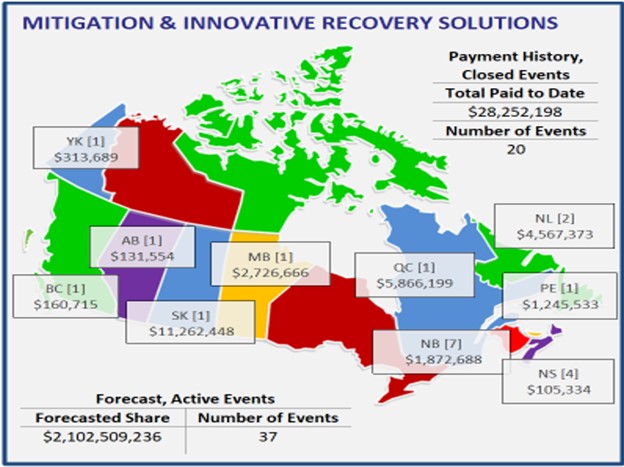
Image description
This image is titled Mitigation and Innovative Recovery Solutions. It depicts the amount paid by DFAA to each province. Yukon received $313,689 for 1 event. BC received $160,715 for 1 event. Alberta received $131,554 for 1 event. Saskatchewan received $11,262,448 for 1 event. Manitoba received $2,726,666 for 1 event. Quebec received $5,866,199 for 1 event. New Brunswick received $1,872,688 for 7 events. Nova Scotia received $104,334 for 4 events. Prince Edward Island received $1,245,533 for 1 event. Newfoundland and Labrador received $4,567,373 for 2 events.
A total of $28,252,198 was paid for 20 events across Canada.
37 events are forecasted / active, and $2,102,509,236 is forecasted to be provided.
| Province/Territory | Contributions to date | Outstanding liabilities | Total events |
|---|---|---|---|
| NL | $200,407,367 | $46,644,603 | 28 |
| PE | $76,074,528 | $51,765,567 | 13 |
| NS | $193,755,703 | $106,475,561 | 25 |
| NB | $210,792,363 | $205,717,458 | 41 |
| QC | $1,513,409,651 | $341,216,028 | 25 |
| ON | $238,951,009 | $0 | 6 |
| MB | $1,490,253,583 | $381,928,974 | 44 |
| SK | $771,148,112 | $187,886,950 | 34 |
| AB | $1,705,145,965 | $655,919,866 | 39 |
| BC | $2,876,324,660 | $3,280,702,578 | 49 |
| YK | $20,518,314 | $19,041,494 | 15 |
| NT | $200,838,774 | $154,649,494 | 15 |
| NU | $4,507,509 | $0 | 1 |
| Grant Total | $9,502,127,537 | $5,431,949,049 | 335 |
| Province/Territory | NL | PE | NS | NB | QC | ON | MB | SK | AB | BC | YK | NT | NU |
|---|---|---|---|---|---|---|---|---|---|---|---|---|---|
| Active events | 6 | 2 | 7 | 14 | 7 | 0 | 9 | 14 | 8 | 12 | 5 | 4 | 0 |
DFAA process/lifecycle
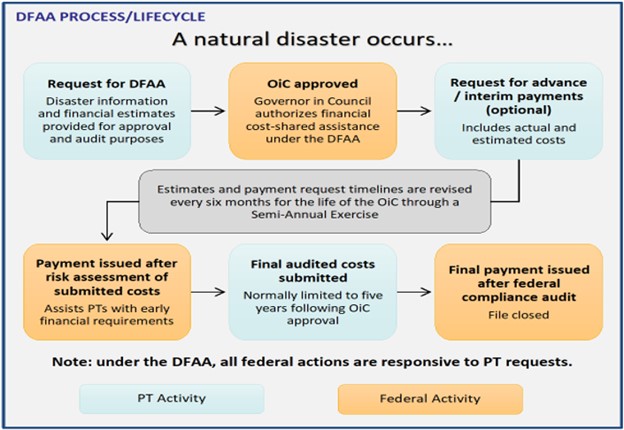
Image description
This image depicts what the DFAA Process and lifecycle is when a natural disaster occurs. First, you put in a request through the DFAA. This is a PT activity. Disaster information and financial estimates are provided for approval and audit purposes. Then, the Order in Council is approved. This is a Federal Activity. The Governor in Council authorizes financial cost-shared assistance under the DFAA. Then, the request is made for advance / interim payments. This is a PT activity. This step is option and can include actual and estimated costs. Every six months, estimates and payment request timelines are revised for the life of the OiC through a Semi-annual exercise. Then, payment is issued after risk assessment of submitted costs. This is a Federal Activity. This assists PTs with early financial requirements. Then, the financial audit costs are submitted. This is a PT activity. Normally, this is limited to five years following the OiC's approval. Finally, the final payment is issued after a federal compliance audit. This is a Federal Activity. The file is now closed.
Note: under the DFAA, all federal actions are responsive to PT requests.
Program figures
- 346 requests for DFAA since 1970
- 227 events that have received a final payment
- 162 events approved under the 2008 Guidelines
- 88 active DFAA events
- 16 events with PS for final audit review
- 7 requests for assistance pending approval
- 13 events with a Federal share >$300 million
- 8 average DFAA lifecycle, in years
- 37 average duration of disaster, in days
- 8 average OiCs approved, by fiscal year
- 8 average Payments issued, by fiscal year
Fiscal year at a glance (1970 to present)
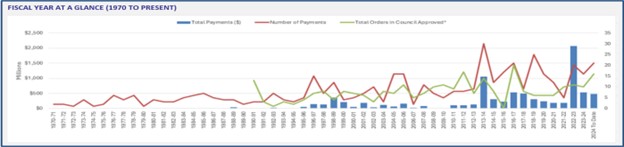
Image description
This graph depicts the amount of payment through DFF, number of payments, and total related orders in council. It starts in 1970 and goes to 2024.
It starts in 1970 and goes to 2024. The amounts paid out, number of payments, and related orders in council are all increasing over time. There are two years of note for DFAA payments: 2013-14 and 2023-24.
Canadian Red Cross: Supporting urgent relief efforts: supporting the canadian red cross's urgent relief efforts related to covid-19, floods and wildfires
Program description and objective
Supporting the Canadian Red Cross's Urgent Relief Efforts Related to COVID-19, Floods and Wildfires is a contribution program that will provide funding to the Canadian Red Cross (CRC) so that it may respond to COVID-19 as well as to floods and wildfires which will present new and unprecedented challenges related to the pandemic context.
The objective of the Program is to enable the Canadian Red Cross to support Canadians' needs stemming from COVID-19, floods and wildfires.
Through the provision of funding to the CRC under this program, the CRC will have the resources to reduce the impact of COVID-19, floods and wildfires on Canadians.
Assessment - merit
- CRC will be required to submit its project proposals to PS;
- Initial review and analysis against the Terms and Conditions of the program;
- After initial review, PS will table the proposal at a Special ADM-EMC meeting, chaired by PS, for a whole of-government discussion;
- The Chair of ADM-EMC (PS) will seek the Assistant Deputy Minister- Emergency Management Committee (ADM-EMC) recommendation with respect to the CRC's proposal;
- If the ADM-EMC's consensus is to recommend the proposal, the Chair of ADM-EMC (PS) will bring the proposal forward to the Deputy Ministers' Emergency Management Committee (DM-EMC) for consideration;
- The Chair of the DM-EMC (PS) will seek the DM-EMC's recommendation;
- The final funding decision rests with the Minister of Public Safety and Emergency Preparedness.
- Eligible proposals will be assessed on merit criteria such as but not limited to:
- Demonstrated need;
- Alignment with federal government funding priorities;
- Avoidance of duplication;
- Timeliness and feasibility;
- Effectiveness and efficiency;
- Demographic reach (with consideration for vulnerable populations); and,
- Expected results (project impact).
Note: Given the nature of the program and that some projects may require urgent approval, the project review process and governance may need to adapt/be modified in order to expedite approvals.
Eligible Recipients and Cost Sharing and Stacking Limits
| Eligible recipient | Cost |
|---|---|
| The sole eligible recipient of this Program is the Canadian Red Cross Society. | 100% |
Eligible expenditures
- Salary, including benefits and OT for paid administrative and operational employees engaged in eligible activities;
- Emergency equipment and supplies (such as PPE, medical supplies, cots, tents, etc.)
- Medical equipment;
- Movement and transportation of equipment;
- Material shipping & handling;
- Transportation services;
- Sustainment of deployed personnel and volunteers;
- Operational supplies (such as emergency social services and basic needs: emergency lodging, food and clothing for individuals and families)
- Expenditures associated with contracts for which the CRC engages to provide services for eligible activities;
- Minor capital acquisitions net of disposal ($10,000 or less per acquisition);
- Program supplies and materials ($10,000 or less per acquisition);
- Travel and living expenses related to the delivery of the project;
- Rental (equipment);
- Rental (facilities);
- Computer services, research costs and collection and analysis of statistics;
- Translation and simultaneous interpretation activities;
- Printing and distribution activities directly related to eligible activities;
- Payments to Canadians, small business and non-government organizations (as financial assistance under STREAM 1 - Supporting Small Businesses and Non-Government Organizations Response and Recovery and STREAM 2 - Financial Assistance to Affected Populations);
- Costs associated with restoring infrastructure to a level exceeding its pre-disaster condition for enhanced resilience (subject to limitations set out in section 11);
- Decontamination of private property and infrastructure, and public infrastructure to a level exceeding its pre-disaster condition (subject to limitations set out in section 11);
- Repairs to a non-primary dwelling, and building materials associated with said reconstruction (subject to limitations set out in section 11); and
- Hospitality in the Indigenous context will be considered as an eligible expense for:
- Gatherings, feasts, ceremonies, circles
- Other costs, as approved in writing by the Minister of Public Safety and Emergency Preparedness.
The CRC is authorized to apply a 12% administrative flat fee against the actual eligible expenditures incurred in order to cover indirect costs, including overhead, and this flat fee is an eligible expenditure.
In special circumstance, for approved projects, eligible expenditures incurred after receipt of funding application and project proposal by PS but prior to formal approval may be considered eligible for reimbursement.
Ineligible expenditures
- Capital costs, such as land, buildings, vehicles and most other capital costs (more than $10,000 per acquisition), except for medical equipment under eligible expenditures above;
- Hospitality, except in the Indigenous context as described above under eligible expenditures;
- Core or ongoing operating expenses;
- Amortization and interest (cost of borrowing);
- Travel not directly related to the project; and
- Profit, defined as an excess of revenues over expenditures.
Tombstone data
- Created in May 2020
- Total Envelope: $233.6 M
- Source of funds:
- Off-cycle funding decision by the Minister of Finance and the Prime Minister in the amount of up to $100,000,000 to support the Canadian Red Cross (CRC) for urgent relief efforts related to COVID-19, floods and wildfires.
- [REDACTED] an additional $35M for outbreak crisis management and the transfer of $35M from the Safe Restart Agreement for assistance to testing.
- The Government of Canada announced it would match donations to the CRC for specific large-scale events, totaling $86.1M from 2022–23 to 2025–26:
- 2021 BC Wildfires: $4.6M
- 2021 BC Floods: $33.3M
- 2022 Hurricane Fiona: $25.7M
- 2023 AB Wildfires: $7.5M
- 2023 NS Wildfires: $5M
- 2024 AB Wildfires: $10M (final numbers to be confirmed)
- Number of projects funded since inception: 25
- Number of Calls for Applications: N/A
Funding profile (with CRC forecast)
| Fiscal year | 2022–23 | 2023–24 | 2024–25 | 2025-26 |
|---|---|---|---|---|
| Funding Envelope | $32,760,047.8 | $21,885,516.80* | $9,000,000.00* | 11,330,987.78* |
| Forecast | $27,567,365.59 | $8,464, 266.52 | TBD | n/a |
| Actuals | $32,760,047.8 | $21,885,516.80* | $10,320,000.00* | $11,330,987.78* |
| Balance | $5,192,682.21 | $13,391,250.28 | n/a | n/a |
| *[REDACTED] | ||||
Current status
- Last Call for Applications: N/A – Directed
- Number of proposals received: 26
- Total funding commitment: $230.19M (rounded)
- Number of recommended applications: 20 (under V5)
- Additional comments:
- Minor Amendment approved March 22, 2023 to extend the program to March 31, 2026 to account for donation matching.
- Applications under Stream 2 – Response now fall under the Humanitarian Workforce Program.
Supporting a humanitarian workforce: Supporting a humanitarian workforce to respond to covid-19 and other large scale emergencies
Program description and objective
The Supporting a Humanitarian Workforce to Respond to COVID-19 and Other Large-Scale Emergencies Program ("the Program") is a contribution program that will provide funding to non-governmental organizations (NGOs) so that they may build capacity and deploy to respond to COVID-19 and other large-scale emergencies.
This Program will support readiness and specific deployments of NGOs by providing them with some targeted funding to bolster their readiness capacity and deployment ability> The development of a humanitarian workforce will thus strengthen the preparedness and emergency response capacity in Canada by leveraging the contributions of the NGOs, as well as by enhancing whole-of-society collaboration. This Program will enhance and maintain a humanitarian workforce to provide an agile and responsive surge capacity.
Assessment - merit
- Applicants will be required to submit their project proposals to PS;
- Initial review and analysis against the Terms and Conditions of the Program;
- After initial review, PS will table the proposal at a Special Deputy Minister – Emergency Management Committee (DM-EMC) meeting, chaired by PS;
- The Chair of DM-EMC (PS) will seek the Committee's recommendation with respect to proposals;
- The final funding decision rests with the Minister of Public Safety and Emergency Preparedness;
- For Deployments, funding prioritization criteria would include:
- Demographic and geographic reach and accessibility
- The extent a proposal addresses the most urgent need including vulnerable populations
- The specific skills, capacities and capabilities of an organization for the proposed project
- Value for Money
- Specific requirements and preferences of requesting jurisdictions
- The distribution of funding support provided to organizations to date
- For Capacity-Building, eligible proposals will be assessed on merit criteria such as but not limited to:
- Extent to which the project builds capacity to respond to urgent relief need(s) and/or to respond to a range of large-scale emergencies
- Extent to which the project builds capacity not already available
- Extent to which the project builds capacity to respond to the unique needs of vulnerable populations
- Timeliness and feasibility
- Effectiveness and efficiency
- Demographic reach (with consideration for vulnerable populations)
- Expected results (project impact)
| Fiscal year | 2023-24 | 2024-25 | 2025-26 |
|---|---|---|---|
| Funding Envelope | $35,000,000 | $35,000,000 | $35,000,000 |
| Forecast | $27,757,842.35 | $30,844,985.95 | $29,722,300.60 |
| Actuals | $27,809,362.35 | $12,964,695.45* | n/a |
| Balance | $0.00 | $19,871,541.30 ($4.16M remaining uncommitted) |
$29,722,300.60 ($5.28M remaining uncommitted) |
| * to date | |||
Note: Given the nature of the Program and that some projects may require urgent approval, the project review process and governance may need to adapt/be modified in order to expedite approvals.
Eligible expenditures
- Salary, including benefits and OT for paid administrative and operational employees engaged in eligible activities;
- Emergency equipment and supplies (such as PPE, medical supplies, cots, tents, etc.)
- Medical equipment;
- Movement and transportation of equipment;
- Material shipping & handling;
- Transportation services;
- Sustainment of deployed personnel and volunteers;
- Operational supplies (such as emergency social services and basic needs: emergency lodging, food and clothing for individuals and families);
- Professional services (e.g. legal, accounting, and auditing activities, should the capacity not already exist in the organization);
- Incremental insurance fees for operations;
- Minor capital acquisitions net of disposal ($10,000 or less per acquisition);
- Program supplies and materials ($10,000 or less per acquisition);
- Travel and living expenses related to the delivery of the project;
- Rental (equipment and/or facilities);
- Computer services, research costs and collection and analysis of statistics;
- Translation and simultaneous interpretation activities;
- Printing and distribution activities directly related to eligible activities;
- Costs associated with restoring infrastructure to a level exceeding its pre-disaster condition for enhanced resilience (subject to limitations set out in section 11);
- Decontamination of private property and infrastructure, and public infrastructure to a level exceeding its pre-disaster condition (subject to limitations set out in section 11);
- Repairs to a non-primary dwelling, and building materials associated with said reconstruction (subject to limitations set out in section 11);
- Hospitality in the Indigenous context will be considered as an eligible expense for gatherings, feasts, ceremonies and circles
- Other costs, as approved in writing by the Minister of Public Safety and Emergency Preparedness.
Recipient organizations are authorized to apply a 12% administrative flat fee against the actual eligible expenditures incurred in order to cover indirect costs, including overhead, and this flat fee is an eligible expenditure.
In special circumstance, for approved projects, eligible expenditures incurred after receipt of project proposal by PS but prior to formal approval may be considered eligible for reimbursement.
Ineligible expenditures
- Capital costs, such as land, buildings, vehicles and most other capital costs (more than $10,000 per acquisition), except for medical equipment under eligible expenditures above;
- Hospitality, except in the Indigenous context as described above under eligible expenditures;
- Core or ongoing operating expenses;
- Amortization and interest (cost of borrowing);
- Travel not directly related to the project; and
- Profit, defined as an excess of revenues over expenditures.
Supporting a humanitarian workforce: Supporting the canadian red cross's urgent relief efforts related to covid-19, floods and wildfires
Eligible recipients
- All eligible recipients that may submit a funding proposal under this program must demonstrate:
- A presence in, and ability to provide domestic services in, Canada (including having a distinct Canadian chapter).
- That they are Incorporated under Canadian law.
- That they Operate as a not-for-profit organization.
- National Reach.
- History (over the last five years) of mobilizing equity to respond to large-scale domestic emergencies, such as floods, wildfires and pandemics.
- Capacity to enter into a contribution agreement with PS and to undertake project and financial monitoring and reporting activities.
- Capabilities and five years' experience in one or more key areas:
- Public health and emergency medical services (to provide rapid lifesaving medical services to reduce illness, injury and death)
- Emergency operational coordination (to establish and maintain coordinated disaster management and operational structures that integrates all EM partners at all levels
- Emergency logistics (to deliver essential commodities, equipment, and services in support of impacted communities);
- Emergency social services (to provide short-term social services to the.affected or displaced populations – i.e., emergency lodging, food, clothing, personal services, reception centre)
- Training and education (to conduct training, certification and education to improve the performance, knowledge and interoperability of relevant EM partners)
- Psychosocial health (to provide crisis and behavioral health support for affected persons, with an emphasis to reducing future risk)
- Specialized response resource – disaster search and rescue (to support and or deliver and sustain search and rescue capability needs in impacted areas)
- Working with, or providing support to, one or more groups such as the following: socially or economically marginalized communities, indigenous peoples, or diverse ethno-cultural communities)
- Ability to provide services in both official languages.
- Current recipients include but are not limited to the Canadian Red Cross, St. John's Ambulance, Search and Rescue Volunteers Association of Canada, The Salvation Army, and Team Rubicon Canada.
Cost Sharing: 100%
Tombstone data
- Created In: June 2021
- Total Committed to Date: $188.1M
- Source of Funds: 2020 Fall Economic Statement
- Number of projects funded since inception: 30
- Number of Calls for Applications: N/A
Project streams and eligible activities
Stream 1 – Emergency readiness; Capacity building
Eligible activities include:
- strengthening governance, management, training, and operations systems;
- Adapting protocols and procedures to address the needs of specific; communities and to address barriers to participation;
- Recruitment and training of personnel/volunteers;
- adapting protocols, procedures or techniques to the COVID-19 context; and
- Cultural competency training and cultural safety.
Stream 2A – Supporting emergency response and recovery through risk reduction
Eligible activities include:
- facilitating community risk reduction through education, assessment and implementation of risk-reduction protocols;
- Complementing the implementation and operations of quarantine sites, isolation sites and evacuation centres;
- Providing training on preventing disease transmission and the use of personal protective equipment;
- Coordinating the acquisition and distribution of emergency response supply; and
- Supporting non-governmental organizations response and recovery
Stream 2B – Providing health services
Eligible activities include:
- Providing information and referrals
- Emergency social services
Stream 2C – Surge health and emergency management services
Eligible activities include
- Deployment of Emergency Response teams
- Deployment of testing assistance teams
- Outbreak crisis management
- Support to a national vaccination program
- Support for emergency management response and recovery
- Date modified: