Introduction Emergency Management and to the Government Operations Centre (May 2025)
On this page:
- Purpose
- Canadian Emergency Management Overview
- Key Ministerial Responsibilities
- Ministerial Authorities
- Government Operations Centre
- Emergency Response Levels
- Plans and Frameworks (examples)
- The Federal Emergency Response Plan
- Governance - High Level Roles and Responsibilities
- Normal Day to Day Situational Awareness and Information Dissemination
- Requests for Federal Assistance
- Types of Requests for Federal Assistance
- Other types of Federal Supports
- Annex A: What is the Request for Federal Assistance Process?
- Annex B: Single Window for Requests for Federal Assistance
- Annex C: 26 Federal Institutions
- Annex D: Federal Emergency Support Functions
Purpose
This deck presents an overview of the Government of Canada's Emergency Management (EM) system, related Ministerial authorities and responsibilities and the federal EM response system, highlighting key elements including:
- The role of the Government Operations Centre (GOC) in the Emergency Management and Programs Branch (EMPB)
- The Federal Emergency Response Plan (FERP)
- Requests for Assistance (RFA)
Canadian Emergency Management Overview
Most emergencies are local in nature and are handled by local or provincial/territorial (PT) authorities.
When an emergency requires capabilities beyond those of a PT jurisdiction, they can submit a RFA. The number of RFAs has doubled since 2019 as the intensity of disaster events continues to increase.
When an emergency touches a federal government jurisdiction (e.g.: national security incident, event affecting First Nation on-reserve community), the federal government may take action.
Jurisdictions in Canada adopt an all-hazards approach by addressing vulnerabilities arising from natural and human-induced hazards and disasters.
Emergency events are increasing due to factors that include climate change, expanding cities, and reliance on critical infrastructure.
To date, efforts to support disaster recovery have had little impact in terms of incentivizing resiliency. Recent changes to federal programs are addressing this issue.
Key Ministerial Responsibilities
In practice, day-to-day responsibilities for EM are exercised though the EMPB within Public Safety Canada (PS).
Core activities for the Minister include:
- Providing information and advice to the Prime Minister and to Cabinet colleagues in times of crisis
- Approving RFAs received from PTs during emergencies
- Leading engagement with PT Ministers responsible for EM and National Indigenous Leaders
- Leading the development and implementation of policies, plans, programs, and strategies to prepare for, mitigate, and respond to emergencies across the country
- Communicating with the public and the media to provide information and updates during crises, and more broadly to raise risk awareness and educate on federal disaster resilience efforts
- Working with other federal ministers with EM responsibilities to strengthen EM collaboration and integration
- Reporting to Parliament and the public about the government's EM efforts, ensuring accountability for decisions made during crises
Ministerial Authorities
The Minister of Public Safety and Emergency Preparedness has the legislated responsibility to exercise leadership relating to EM in Canada, including coordinating EM activities among government institutions and in cooperation with the provinces and other entities, EM activities.
In 2021, an Order in Council established the role of the Minister of Emergency Preparedness, who shared these responsibilities with the Minister of Public Safety.
A 2024 Order in Council transferred the powers, duties and functions of the Minister of Public Safety under section 7 of the Emergency Management Act (EMA) to the Minister of Emergency Preparedness.
PS understands that the Privy Council Office will work to ensure that authorities are appropriately transferred to the Minister of Emergency Management and Community Resilience.
Through its Minister(s), Public Safety Canada (PS) has the legislative mandate to build a safe and resilient Canada by working with other federal departments and agencies, PTs, national and regional Indigenous organizations, as well as other stakeholders to advance policy, program and outreach across all pillars of EM.
Within PS, the GOC supports preparedness for and leads the coordination of the integrated federal response to all-hazard events.
Outside of PS, all federal ministers are responsible under the EMA (Section 6) for developing and exercising EM plans in relation to risks in their areas of accountability, meaning a decentralization of EM activities that cut across federal areas of responsibility.
Government Operations Centre
The GOC, established in 2004 under the National Security Policy, is Canada's national hub for 24/7 EM situational awareness and the federal coordination of consequence management for all disasters within federal jurisdiction and where events exceed PT capacity.
The GOC is implicated in 2 pillars of EM – Preparedness and Response.
The Federal Emergency Response Plan (FERP) codifies the roles, responsibilities and accountabilities of the GOC and specific departments that have an integral role in national safety.
Preparedness:
- Support preparedness for events
- EM Planning
- Policy development related to Emergency Preparedness and Response
- Exercising
- Hazard monitoring and warning
- Leading Hotwash and After Action Reports to better identify areas to improve
Response:
- Coordinate federal response to events
- Providing situational awareness to decision-makers
- Hazard and risk assessment
- Geospatial support
- Situational assessment
- Operational communications between federal operations centres
Other departments with EM responsibilities:
- Have the policy and legal mandate in their area of responsibility, where they are the lead department
- Provide generalized or specialized assistance to a lead department in response to an emergency, where they provide a support function
Emergency Response Levels
The GOC will activate to higher levels of response depending on scope and urgency of the event.
Baseline
The GOC monitors against set Reporting Criteria to develop and disseminate products such as the GOC Daily Operations Brief for partners to keep them informed of upcoming and ongoing events of national interest.
GOC Notifications are issued to federal, provincial, and territorial partners and offices when an ongoing or emerging event meets pre-determined criteria.
Flash Alerts are sent to senior decision-makers, primarily Deputy Ministers (DM), to inform them of events that have not yet met the threshold for reporting.
Level 1: Enhanced Reporting
The GOC focuses on raising awareness through increased monitoring and reporting, enhancing communication and information flow between PS Regional Offices, the GOC, and their respective partners.
Level 2: Risk Assessment and Planning
The GOC assesses risks, threats, their potential impacts, resource needs, and response gaps to identify potential federal involvement. Based on this assessment, an integrated response plan can be developed, and partners are preparing to send Subject Matter Experts and Liaison Officers to the GOC.
Level 3: Coordination of Federal Response
The GOC collaborates with PS Regional Offices to anticipate and coordinate RFAs, and may send Subject Matter Experts and Liaison Officers to ROs for effective federal-national and regional-federal coordination.
Plans and Frameworks (examples)
The GOC's approach to managing emergencies is guided by a series of plans and frameworks:
- The overarching all-hazards framework is the FERP which coordinates overall Government of Canada response for emergencies
- Terrorism: Provides strategic situational awareness and high level coordination for consequence management and associated planning in complex situations involving a terrorist incident in Canada – Federal Terrorism Response Plan
- Cyber: Coordinates overall Government of Canada response to a national cyber security crisis – Government of Canada Cyber Security Event Management Plan
- Maritime: Coordinates interdepartmental response – Maritime Event Response Protocol ; and is the Canadian point of entry with the Department of Homeland Security's Global Maritime Operational Threat and Response Coordination Centre
- Air: Key actor in the Passenger Protection Program; provides advice to the Minister of Public Safety
The Federal Emergency Response Plan
The FERP is the all-hazards framework that guides federal emergency response operations.
It outlines federal governance, roles and responsibilities - including alignment with those of PTs, non-governmental organizations, and the private sector. Federal response plans developed by other departments should align with the FERP, which applies to all-hazards domestic events, or international events that have a domestic impact.
Federal Institutions' responsibilities:
- Per the EMA legislation, all federal ministers are responsible for preparing, maintaining, and exercising EM plans for risks within or related to their areas of responsibility
- The 13 Emergency Support Functions (ESFs) are aligned with Federal Institutions in a manner consistent with their organizations' mandates
FERP (thus GOC) activated when:
- Emergency impacts multiple jurisdictions
- Federal assets, services, employees, etc. implicated
- National interest affected
- RFA received
GOC does:
- Convene, collaborate, coordinate and communicate federal response, including response to RFAs, to allow lead departments to focus on fulfilling their mandates
- Monitors and synthesizes information to ensure federal situational awareness and to support decision makers
Currently GOC does not:
- Take on responsibility of other departments or agencies to deliver on their mandate
- Control assets or envelopes of funds to respond to events
- Make decisions - but does facilitate whole-of-government recommendations for decision makers
- Coordinate responses that can be managed within routine operations, even among multiple departments
ESFs in response:
- Primary institutions lead effective coordination among their ESF partners and with other ESFs and the GOC, ensuring essential EM functions are available when required
There are clear Ministerial accountabilities regarding federal emergency response plans, but a whole-of-government aligned EM approach is needed. To this end, work to renew the FERP is ongoing.
Governance - High Level Roles and Responsibilities
There is a strong governance system in place for EM activities, and all partners are engaged in regular planning and preparedness activities.
During events, the governance is integral for maintaining visibility and engagement at all levels (as required and appropriate).
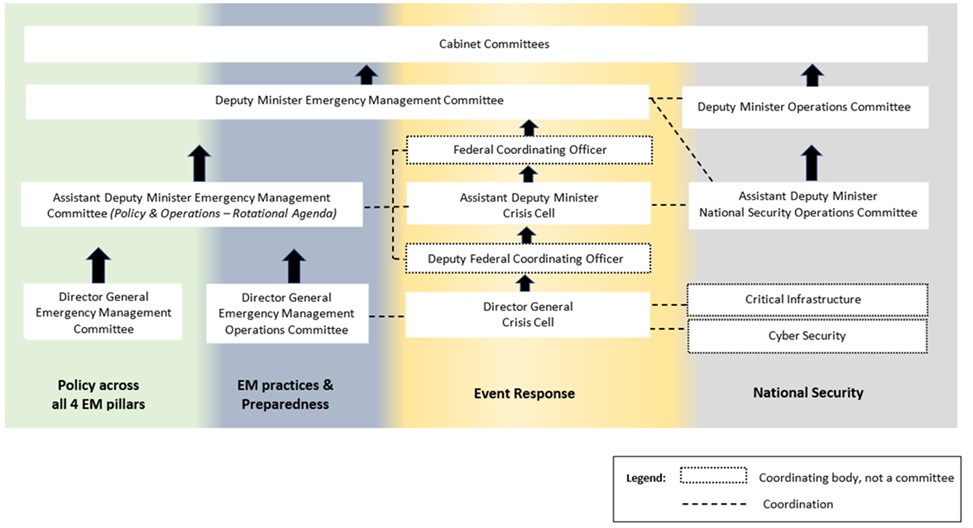
Image description
There are four governance tracts depicted in this image. The first, represented in green, relates to policy across all four EM pillars. The second, represented in blue, relates to EM practices and preparedness. The third, represented in yellow, relates to event response. The fourth, represented in grey, relates to national security.
For policy, governance starts with the Director General-level Emergency Management Committee. That feeds into the Assistant Deputy Minister-level EM Committee, which covers policy and operations and has a rotational agenda. That feeds into the DM-level EM Committee, which finally feeds into Cabinet Committee.
The EM practices & preparedness tract is the same as the policy tract except that it begins with the Director General-level EM Operations Committee.
For the Response tract, it starts with the Director General Crisis Cell (which has coordination with both the Director General-level EM Operations Committee and the Critical Infrastructure and Cyber Security coordinating bodies). It feeds in the Deputy Federal Coordinating Officer, who feeds into the Assistant Deputy Minister Crisis Cell, which feeds into the Federal Coordinating Officer before feeding into the DM EM Committee. It ends at Cabinet Committee as well.
There is coordination between the Assistant Deputy Minister-level EM Committee, the Assistant Deputy Minister crisis Cell, the Federal Coordinating Officer, and the Deputy Federal Coordinating Officer.
For the National Security tract, it starts with there is the ongoing presence of the Critical Infrastructure and Cyber Security coordinating bodies. However, committee-based governance begins at the Assistant Deputy Minister National Security Operations Committee. That feeds into the DM's Operations Committee which then feeds into, at the end, Cabinet Committee.
There is coordination between the Assistant Deputy Minister Crisis Cell and the Assistant Deputy Minister National Security Operations Committee.
There is coordination between the Assistant Deputy Minister National Security Operations Committee and the DM EM Committee.
Also, there is coordination between the DM EM Committee and the DM Operations Committee.
Normal Day to Day Situational Awareness and Information Dissemination
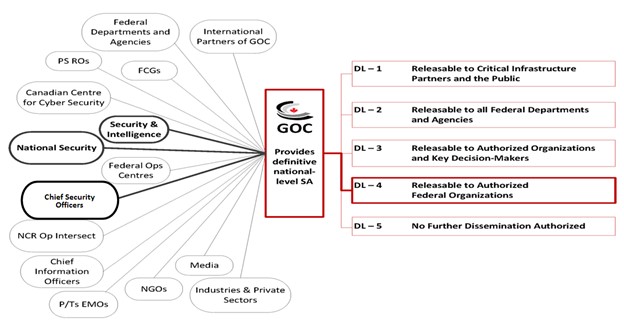
Image description
The GOC stands at the center of normal information dissemination. It provides definitive national-level situation awareness.
Incoming sources of information include: industries and private sectors, media, non-government organizations, PT EM organizations, chief information officers, national capital region operation intersect, chief security officers, federal operations centres, national security, security and intelligence, Canadian centre for cyber security, PS regional offices, federal coordination groups, federal departments and agencies, and international partners of the GOC.
There are five levels of information dissemination. DL-1 is information releasable to critical infrastructure partners and to the public. DL-2 is information releasable to all federal departments and agencies. DL-3 is information releasable to authorized organizations and key decision-makers. DL-4 is information releasable to authorized federal organizations. DL-5 is information where no further dissemination is authorized.
Requests For Federal Assistance
A RFA is the formalization of request to the federal government to provide support in a response to an emergency.
Federal assistance can be requested when a PT has exceeded their capacity to respond, and all other resources have been exhausted.
The GOC, with the PS Regional offices, receive and coordinate RFAs.
Prior to 2020, a baseline for RFAs was 5-10 per year. RFAs peaked in response to COVID-19 (150 RFAs in 2021-2023), and have decreased in a post-pandemic period. With the continuation of the Humanitarian Workforce Program and improved EM literacy across the country, the number of RFAs have not returned to the previous baseline.
Types of Requests for Federal Assistance
Below are the types of RFAs coordinated by the GOC.
General Request for Federal Assistance
- EM requests for federal assistance from PTs or another federal department
- Approved by the Minister of Emergency Preparedness under the EMA
Assistance to Federal Law Enforcement Agencies
- Requests for Canadian Armed Forces (CAF) assistance to police and law-enforcement partners
- Assistance to Federal Law Enforcement Agencies (ALEA) requests from the Royal Canadian Mounted Police (RCMP) as national police force approved by the Minister of Public Safety, who contacts the Minister of National Defence to request CAF support. ALEA requests from RCMP as police of jurisdiction is approved by the Minister of Emergency Preparedness, who contacts the Minister of National Defence to request CAF support
General Request for Federal Assistance with Humanitarian Workforce Program
- EM requests for federal assistance from PTs
- Approved by the Minister of Emergency Preparedness under the EMA
- PS DM approval is required for funding proposal support under the Humanitarian Work Force Program (e.g. CRC)
Delegated Authority
- When many RFAs for CAF support are anticipated, the RFA approval process can be expedited through delegation of authority to the Director General of the GOC. Ministerial discussion depends on complexity or risk level
- An example of this was the Omnibus RFA, signed by both the Minister of Public Safety and the Minister of National Defence, which delegated the authority to approve COVID-19 specific RFAs to senior officials within the federal government
- It was approved in March 2020, reviewed 2021 and closed at the end of 2022
Other types of Federal Supports
There are also non-RFA supports provided through other government departments.
For example, RCMP:
- During the Freedom Convoy protests, the RCMP coordinated federal assistance to provide additional law enforcement resources under sub-article 9 of the Provincial Police Services Agreement
For example, Public Health Agency of Canada (PHAC) and Health Canada (HC):
- During COVID-19, PHAC had been coordinating requests for public health assistance which fall under the mandates of PHAC and HC, such as COVID testing, contact tracing, and outbreak management (Federal Health Human Resources roster, Public Health Rapid Response Team)
- However, these were also part of the single window Director General RFA governance for full visibility and tracking
Other examples of Federal Support:
- Search and Rescue (SAR) – CAF SAR activities are considered life and limb situations. The Department of National Defence has a mandate for CAF SAR
- CAF Provision of Service – If the request is not of an urgent nature, a provision of service can be used
- Federal departments may provide assistance to PTs or other federal departments, within scope of their mandate, without requiring the coordination of PS's GOC. In this case, the decision to involve PS's GOC lies with the assistance provider
Annex A: What is the Request for Federal Assistance Process?
Process:
- PTs and other Federal departments request Federal Assistance. First Nations communities will work in collaboration with PTs and/or Indigenous Services Canada
- Requests are sent to the GOC via the PS Regional Office
- GOC sources federal or private resources
- Minister of Public Safety approves or denies the request
Legislation:
Governance:
- DM EMC and Assistant Deputy Minister Crisis Cell
Assessment Criteria:
- Due Diligence and Assessment of Need
- Provincial resources are exceeded and exhausted
- Provincial prioritization was undertaken
- No regional solution (Federal Coordination Group)
- Capacity to address the gap and residual capacity
- Hazard, vulnerabilities, probability and likelihood of impact, mitigation efforts and gaps
- Prioritization
- Feasibility, effectiveness, efficiency and expected results
- Demographic reach
- Regional balance
- CAF Considerations
- "Last resort" option
- The CAF cannot replace viable commercial options
Annex B: Single Window for Requests for Federal Assistance
For EM RFAs:
- Legislation: EMA, National Defence Act
- Governance: Assistant Deputy Minister Crisis Cell, DM EM Committee and Minister of Public Safety
For Public Health Request for Assistance:
- Governance: Health Portfolio
Federal Resources:
- EM RFA
- PS Funding Programs for Outbreak Management (Humanitarian Workforce Program)
- Logistics/Transportation Support
- Assistance to Civil Order
- Employment of the CAF
- Public Health RFA
- Testing Assistance
- Operational framework for mutual aid requests
- Provision of Testing Equipment
- Laboratory Services
- Outbreak Management (Federal Health Human Resources Roster)
- Public Health Rapid Response Team
- Contact Tracing Support
- Isolation Sites
RFA:
- EM RFA:
- Only PTs and Other Federal Departments can request Federal Assistance
- RFAs are sent to the GOC via the PS Regional Offices
- Public Health RFA
- PT can request public health assistance
- Request for public health assistance and federal Health Surge Assistance sent to PHAC COVID Support
Federal Assessment and Prioritization:
- Validity of Request
- Local/PT resources are exhausted
- Support is temporary and not long term
- PT has performed prioritization
- Demonstrated need
- Availability of federal resources
- Appropriate, deployable federal capacity
- Impact on readiness for future deployments
- Defined, feasible time horizon for deployment of federal resources
- Time-limited responses with clear exit strategies
- Nature of situation/outbreak
- Acuteness of hazard
- Support to vulnerable populations
- Capabilities and gaps
- Risks in the absence of adequate support
- Previous federal engagements
- Request reduced to minimum acceptable to address situation/outbreak
- Regional circumstances
- Regional considerations (i.e., limited capacity in rural/remote)
- Equitable distribution of federal resources
- Plans permitting eventual pull out of federal resources
- Public health measures preventing transmission
- Steps taken to minimize need to the extent possible
Best Practices:
- Early engagement of the Regional Office
- Sharing the Draft letter with the PS Regional Office and GOC
- Communicating clearly defined effects and gaps
- Highlight the alternatives that have been looked at
- Define the time required for support
- Describe PT actions to resolve the situation to limit the use of federal resources
Annex C: 26 Federal Institutions
- Transport Canada
- Innovation, Science and Economic Development Canada
- Agriculture and Agri-Food Canada
- Canadian Food Inspection Agency
- Natural Resources Canada
- PHAC
- HC
- Environment and Climate Change Canada
- RCMP
- Global Affairs Canada (GAC)
- PS
- Canada Border Services Agency
- Immigration, Refugees and Citizenship Canada
- Canadian Nuclear Safety Commission
- Canada Post
- Communications Security Establishment Canada
- Canadian Security Intelligence Service
- Department of Fisheries and Oceans Canada / Canadian Coast Guard
- Crown-Indigenous Relations and Northern Affairs Canada
- Indigenous Services Canada
- Department of Justice
- Privy Council Office
- Department of National Defense
- CAF
- Employment and Social Development Canada
- Public Services and Procurement Canada
Annex D: Federal Emergency Support Functions
| Emergency Support Function | Primary Institutions (Response Leads) | |
|---|---|---|
| ESF 1 | Transportation | Transport Canada |
| ESF 2 | Tele-communications | Innovation, Science and Economic Development Canada |
| ESF 3 | Agriculture and Agri-Food | Agriculture and Agri Food Canada/Canadian Food Inspection |
| ESF 4 | Energy Production and Distribution | Natural Resources Canada |
| ESF 5 | Public Health and Essential Human Services | HC/ PHAC |
| ESF 6 | Environment | Environment and Climate Change Canada |
| ESF 7 | Human and Social Services | Employment and Social Development Canada |
| ESF 8 | Law Enforcement | RCMP |
| ESF 9 | International Coordination | Global Affairs Canada |
| ESF 10 | Government Services | Public Services and Procurement Canada |
| ESF 11 | Logistics Operations Management | PS |
| ESF 12 | Communications | PS |
| ESF 13 | Border Services | Canada Border Services Agency |
- Date modified: