Overview of Public Safety Canada's Role in Emergency Management: Emergency Management System and Emergency Management and Programs Branch (May 2025)
On this page
- Purpose
- Canadian Emergency Management Overview
- Key Ministerial Responsibilities
- Emergency Management and Programs Branch: Overview
- Policy and Outreach Directorate
- Programs
- Government Operations Centre
- Diversity of Stakeholders in EM System
- Opportunities to Enhance Canada's Resilience
- Annex A: Federal Emergency Support Functions
- Annex B: Requests For Federal Assistance
- Annex C: External Pressures on Canada's EM System
Purpose
- To provide an overview of the Government of Canada's Emergency Management (EM) system and related Ministerial authorities and responsibilities
- To provide an overview of the Emergency Management and Programs Branch (EMPB) at Public Safety Canada (PS), including the organizational structure and major files
Canadian Emergency Management Overview
Most emergencies are local in nature and are handled by local or provincial/territorial (PT) authorities.
When an emergency requires capabilities beyond those of a PT jurisdiction, they can submit a Request for Federal Assistance (RFA). The number of RFAs has doubled since 2019 as the intensity of disaster events continues to increase.
When an emergency touches a federal government jurisdiction (e.g.: national security incident, event affecting First Nation on-reserve community), the federal government may take action.
Jurisdictions in Canada adopt an all-hazards approach by addressing vulnerabilities arising from natural and human-induced hazards and disasters.
Emergency events are increasing due to factors that include climate change, expanding cities, and reliance on critical infrastructure.
To date efforts to support disaster recovery have had little impact in terms of incentivizing resiliency. Recent changes to federal programs are addressing this issue.
Key Ministerial Responsibilities
In practice, day-to-day responsibilities for EM are exercised though the EMPB within PS.

Image description
The four pillars of emergency management are represented by four arrows signifying the order of priority and need: First, in an orange arrow, we have prevention and mitigation. Second, in a red arrow, we have preparedness. Third, in a blue arrow, we have response. And last, in green, we have recovery. The colours are to show distinction and have no inherent meeting themselves.
Core activities for the Minister include:
- Providing information and advice to the Prime Minister and to Cabinet colleagues in times of crisis
- Approving RFAs received from PTs during emergencies
- Leading engagement with PT Ministers responsible for EM and National Indigenous Leaders
- Leading the development and implementation of policies, plans, programs, and strategies to prepare for, mitigate, and respond to emergencies across the country
- Communicating with the public and the media to provide information and updates during crises, and more broadly to raise risk awareness and educate on federal disaster resilience efforts
- Working with other federal ministers with EM responsibilities to strengthen EM collaboration and integration
- Reporting to Parliament and the public about the government's EM efforts, ensuring accountability for decisions made during crises
Emergency Management and Programs Branch: Overview
EMPB supports the Minister's legislative mandate to build a safe and resilient Canada by providing national leadership in the development and implementation of policies, plans, and programs.
EMPB works with other federal departments and agencies, PTs, Indigenous organizations, and others, to advance an integrated policy, programmatic and operational approach across the four pillars of EM. EMPB houses three directorates: the Policy and Outreach Directorate (POD); the Government Operations Centre (GOC); and the Programs Directorate.
EMPB is also responsible for five Regional Offices across Canada, which serve as the primary point of contact for the Department at the regional level. They play an important role in building and maintaining partnerships for EM operations and in supporting communities (e.g.: help to negotiate RFAs).
Key partners include non-governmental organizations (NGOs) (e.g.: Canadian Red Cross, St. John's Ambulance, The Salvation Army, Search and Rescue Volunteer Association of Canada, the Insurance Bureau of Canada), EM teams (e.g.: Heavy Urban Search and Rescue teams), international organizations (United Nations Office of Disaster Risk Reduction), and other countries (e.g.: United State's Federal EM Agency).
Policy and Outreach Directorate
POD is responsible for developing innovative and effective policies, programs, and strategies to manage the breadth of disaster risks faced across the country. This includes ensuring that federal activities effectively build resilience and reduce long-term impacts of disasters.
POD is also responsible for building and maintaining federal relationships with domestic and international EM partners.
Key Files:
- Outreach and engagement with EM partners
- Modernization of the Disaster Financial Assistance Arrangements (DFAA)
- Humanitarian Workforce/Civilian Response
- Heavy Urban Search and Rescue
- Flood Insurance
- Flood Risk Portal
- National Public Alerting System
- Public Safety Broadband Network
- International engagement on EM and resilience
Programs
The Programs Directorate delivers programming related to disaster recovery, Indigenous policing, crime prevention, exiting prostitution, radicalization, search and rescue, and natural hazard disaster risk reduction and climate adaptation. The Directorate also delivers other smaller programs, like Communities at Risk, Countering Radicalization to Violence, Search and Rescue Programs, etc.
The Programs Directorate is responsible for:
- Delivering most of the Grants & Contribution programs for the department
- Supporting regional EM activities, including the GOC
The Directorate also conducts grants and contributions modernization efforts, in collaboration with the Corporate Management Branch, performs audits, and undertakes outreach and engagement activities to foster relationships with key partners, including PTs and Indigenous organizations.
One of the key EM-related programs is the DFAA, which provides financial assistance to PT governments for response and recovery costs from large-scale disasters caused by natural hazards. The DFAA has contributed over $9 billion since its inception in 1970. A modernized program launched on April 1, 2025.
Program delivery is managed through three divisions in the National Capital Region:
- EM Programs
- Community Safety Programs
- Program Operations
Outside of the National Capital Region, program delivery is managed through the Department's five Regional Offices (Atlantic, Québec and Nunavut, Ontario, Prairies and Northwest Territories, and Pacific).
Government Operations Centre
The GOC is the principal means by which the Minister exercises a leadership role in establishing an integrated federal approach to emergency response as mandated by the Emergency Management Act.
On behalf of the Government of Canada, the GOC operates on a 24/7 basis and in support of deputy heads, departments and agencies at the national (strategic) whole-of-government level.
The GOC coordinates efforts among 13 departments and agencies with EM authorities (see Annex A).
The GOC coordinates federal government preparedness and response to all-hazard events of national interest using the following eight capabilities:
- Hazard and risk assessment
- Hazard monitoring and warning
- Geospatial support
- Information sharing
- EM planning
- Situational assessment
- Operational communications between federal operations centres
- Exercising
Diversity of Stakeholders in Emergency Management System
Players in Canada's EM System span diverse whole-of-society partners.
It includes all levels of government, Indigenous partners and governments, private sector, NGOs and academia.
The multitude of players creates dispersed responsibilities and accountabilities across the system.
International players, while not figured here, also play an important role in Canada's EM system, both from a cross-border perspective as well as via commitments under international conventions.
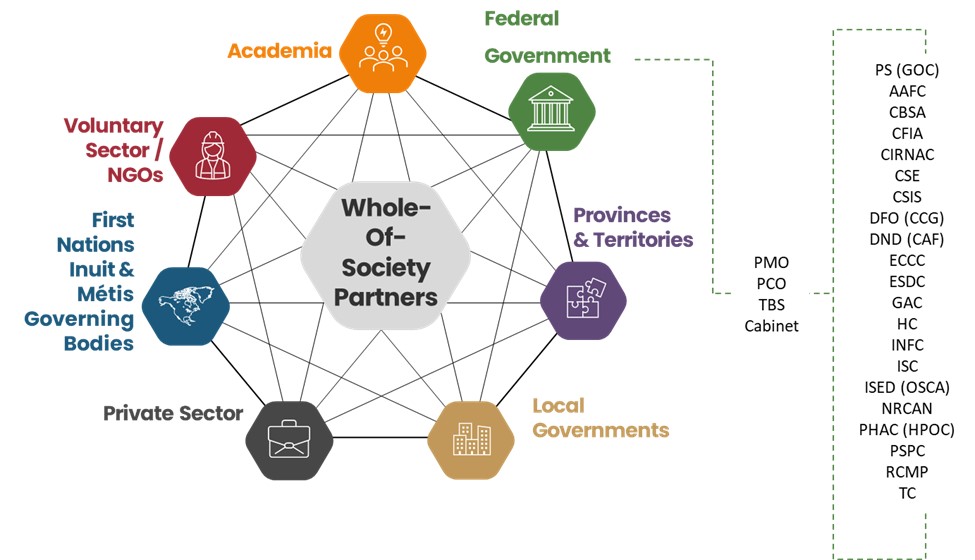
Image description
There are seven main groups of partners who have connections to each of the other groups. The first group is academia. The second group is the voluntary sector and non-governmental organizations. The third group is First Nations and Métis governing bodies. The fourth group is the private sector. The fifth group is local governments. The sixth group is the Provinces and Territories. The seventh and final group is the Federal Government.
The image also groups the Federal Government organizational bodies into two groups. The first group includes the Prime Minister’s Office, the Privy Council Office, Treasury Board Secretariat, and Cabinet. The other group includes all federal departments and agencies responsible for EM. Specifically, that is PS, and GOC in particular, Agriculture and AgriFood Canda, Canada Border Services Agency, Canada Food Inspection Agency, Crown-Indigenous Relations and Northern Affairs Canada, Communications Security Establishment, Canadian Security Intelligence Service, Department of Fisheries and Oceans, the Canadian Coast Guard, the Department of National Defence, the Canadian Armed Forces, Environment and Climate Change Canada, Employment and Social Development Canada, Global Affairs Canada, Health Canada, Infrastructure Canada, Indigenous Services Canada, Innovation, Science and Economic Development Canada, Office of the Chief Science Advisor, Natural Resources Canada, Public Health Agency of Canada, Health Portfolio Operations Centre, Public Services and Procurement Canada, Royal Canadian Mounted Police, and Transport Canada.
The Government of Canada supports partners through a variety of policy, programmatic and operational instruments.
For example, PS's Humanitarian Workforce Program funds the capacity building and deployments of 5 NGOs to support requests for federal assistance from PTs.
Opportunities to Enhance Canada's Resilience
A strong EM system is meant to help make Canada resilient in the face of emergency events. Economic security, national security and community resilience are mutually re-enforcing characteristics of a strong Canada.
There is an opportunity for immediate steps and longer-term action to reinforce the system.
Immediate:
- [REDACTED]
Longer term:
- Strengthening the role and impact of the GOC through critical investments and supports
- Working across partners to fill systemic gaps through targeting investments at critical areas based on risk and vulnerabilities, and through enabling stronger coordination across the system
- Working to further build the resilience of Canadian communities through proacting mitigation and preparedness
Annex A: Federal Emergency Support Functions
Within the federal government, numerous departments have a legal mandate in their area of responsibility and play essential roles in EM policy, programs, and operations.
Emergency Support Functions (ESFs) provide the mechanisms for grouping certain functions. Specifically, these are the functions most frequently used in providing federal support to PTs or assistance from one federal government institution to another during an emergency.
| Emergency Support Function | Primary Institutions (Response Leads) | |
|---|---|---|
| ESF 1 | Transportation | Transport Canada |
| ESF 2 | Tele-communications | Innovation, Science and Economic Development Canada |
| ESF 3 | Agriculture and Agri-Food | Agriculture and Agri Food Canada/Canadian Food Inspection |
| ESF 4 | Energy Production and Distribution | Natural Resources Canada |
| ESF 5 | Public Health and Essential Human Services | Health Canada/ Public Health Agency |
| ESF 6 | Environment | Environment and Climate Change Canada |
| ESF 7 | Human and Social Services | Employment and Social Development Canada |
| ESF 8 | Law Enforcement | Royal Canadian Mounted Police |
| ESF 9 | International Coordination | Global Affairs Canada |
| ESF 10 | Government Services | Public Services and Procurement Canada |
| ESF 11 | Logistics Operations Management | Public Safety Canada |
| ESF 12 | Communications | Public Safety Canada |
| ESF 13 | Border Services | Canada Border Services Agency |
Annex B: Requests For Federal Assistance
What is a Request for Federal Assistance?
A RFA is the formalization of a request to the federal government to provide support in a response to an emergency.
When can federal assistance be requested?
When a PT has exceeded their capacity to respond, and all other resources have been exhausted.
How is Public Safety Canada involved?
- The Minister is responsible for coordinating RFAs under the Emergency Management Act
- The GOC, with PS's Regional offices, receive and coordinate RFAs
Process
- PTs and other Federal departments request Federal Assistance. First Nation communities will work in collaboration with PTs and/or Indigenous Services Canada
- Requests are sent to the GOC via the PS Regional Office
- GOC sources federal or private resources
- Minister approves or denies the request
Annex C: External Pressures on Canada's Emergency Management System
Climate Change
Increasing frequency and severity of extreme weather events, including floods and wildfires:
- Fiscal impacts through disaster recovery payments rising at unsustainable rates
- Rising insurance premiums and limited availability of insurance products to cover climate-related disasters, including in higher-risk communities
Land Planning and Emergency Management System Incentives
Canada's EM system may be inadvertently encouraging risk-taking:
- Previous local planning assumptions (e.g.: out-of-date floodplain maps) are being undermined by climate change
- Jurisdictions lack clear incentives to invest in disaster risk reduction – disaster assistance programs reimburse reconstruction in at-risk areas without mitigation
- Local/PT/Indigenous partners increasingly turning to federal government for leadership and resources, including the Canadian Armed Forces
Economic Interdependence and Interconnectedness
Major disasters in one region of Canada can have significant national impacts – a lack of preparedness in one region can have wide-ranging impacts:
- A lack of preparedness in some regions can have wider national impacts during major emergencies, impacting vital trade and transportation networks
- For example, British Columbia floods impacting rail and road transportation networks
Demographic Changes
Changes to demographics are driving the needs to better leverage our strengths and understand vulnerabilities:
- Canadians 65+ among the fastest growing demographics in Canada
- Canada's First Nations, Métis, and Inuit populations are rapidly growing, while national EM governance is not designed for a collaborative approach that leverages their capabilities and knowledge
- Date modified: