Public Safety Canada Portfolio Overview and Organizational Charts
Public Safety and Emergency Preparedness Portfolio
The Public Safety Portfolio is composed of the Department of Public Safety and Emergency Preparedness (the DepartmentFootnote 1, PS) and five agencies: Royal Canadian Mounted Police (RCMP), the Canada Border Services Agency (CBSA), the Canadian Security Intelligence Service (CSIS), the Correctional Service of Canada (CSC), and the Parole Board of Canada (PBC), and three review bodies: the Civilian Review and Complaints Commission for the RCMP (CRCC), the Office of the Correctional Investigator (OCI), and the RCMP External Review Committee (ERC).
The Portfolio is the biggest, non-military Portfolio in the Government of Canada. The Portfolio's 2024-25 budget is more than $10 billion, and it employs over 72,000 full-time equivalents working in every part of the country and internationally. Each organization contributes to the public safety agenda through its unique mandate and responsibilities.
The Department's principal role is to bring strategic focus, coordination and direction to the government's overall safety and security agenda. It plays a key role in the development, coordination and implementation of policies in the areas of national security, community safety, crime prevention, law enforcement and emergency management. The vast majority of the Department's employees work in the National Capital Region. There are also offices located in five regions: Ontario, Quebec and Nunavut, Atlantic, Prairies and Northwest Territories, and Pacific (British Columbia and Yukon), and a presence in Washington, D.C.
The Department provides transfer payments and support to various programs, including crime prevention, border policy, disaster mitigation, preparedness and recovery, search and rescue, serious and organized crime, countering radicalization to violence, cyber security and critical infrastructure. The largest transfer payments include: Disaster Financial Assistance Arrangements, First Nations Policing Program, National Disaster Mitigation Program, Gun and Gang Violence Action Fund and the National Crime Prevention Strategy.
The Department also maintains the Government Operations Centre (GOC), a 24/7 facility that supports preparedness and coordinates the integrated federal response to all-hazard events of national interest (e.g. the 2016 wildfire in Fort McMurray, the 2020 Nova Scotia mass shooting, and the COVID-19 Pandemic).
The RCMP is a complex and multi-faceted organization that provides a wide range of policing services to keep Canada safe. It has a diverse local, federal and international mandate for preventing and disrupting crime, enforcing the law and international peacekeeping. It is the police of jurisdiction covering 75% of Canada, through over 700 detachments that serve 150 municipalities, more than 600 Indigenous communities, and many small and isolated locations, via contracts and community tripartite agreements, such as the First Nations and Inuit Policing Program. It carries out Federal Policing activities in every Province and Territory in Canada, and internationally. The RCMP's work in this area includes: addressing threats to national security, transnational and serious organized crime, security of Canada's border, and the security of significant government-led events and designated officials and dignitaries.
The RCMP uses modern tools and technologies to provide critical front-line support to police operations, and those of our partners, in areas such as forensic analyses, firearms, criminal records, advanced police technologies, combatting child sexual exploitation and locating missing persons.
The CBSA provides integrated border services by enforcing Canadian laws governing trade and travel (as well as international agreements and conventions), facilitating legitimate cross-border traffic, assessing and collecting duties and taxes and interdicting goods and people that pose a potential threat to Canada. This includes immigration enforcement, such as the removal of people who are inadmissible to Canada due to terrorist activities, organized crimes, war crimes or crimes against humanity. While the majority of the Agency's efforts are focused on goods being imported into Canada and thus protecting the health, safety and security of Canadians, government is increasingly seeking to rebalance these efforts across national and economic security. Export related controls, including formal control on dual-use and sanctioned goods, as well as targeted examinations designed to locate contraband (e.g. drugs, stolen vehicles) are increasing, and are increasingly being viewed as part of whole-of-government responses to issues of national and economic security. The CBSA provides services at approximately 1,200 points across Canada and abroad, including international airports, land ports of entry, and remote border crossings. The CBSA is led by a President, who is appointed to a term of no more than five years.
CSIS is Canada's security and intelligence service. It investigates and reports on activities that may be suspected of constituting threats to the Security of Canada and has the authority to take threat reduction measures, subject to limitations. CSIS collects and analyzes threat-related information, which is typically disseminated to government partners through intelligence reports and other intelligence products. Key threats include terrorism, the proliferation of weapons of mass destruction, espionage, foreign interference and cyber-tampering affecting critical infrastructure. CSIS supports other government departments and agencies through its security screening programs. Upon request from the Minister of Foreign Affairs or the Minister of National Defence, CSIS collects foreign intelligence within Canada to support the Government's broader national interests. CSIS has resources dispersed across Canada and internationally to investigate threats and to liaise with domestic and international partners. CSIS is led by the Director, who is appointed to a term of no more than five years. This appointment can be renewed as long as the aggregate term does not exceed ten years.
CSC administers court-imposed sentences of two years or more for adult offenders, supervises offenders on various forms of conditional release in the community, and helps protect society by encouraging offenders to become law-abiding citizens while exercising reasonable, safe, secure and humane control. CSC also administers post-sentence supervision of offenders with Long-Term Supervision Orders for up to 10 years and provides services to victims of crime, such as sharing information about offenders, encouraging victims to voice their safety concerns, and the impact of the offense on them, their family and communities, and providing additional services to support victims. CSC is responsible for the management of 43 institutions. These institutions include: six maximum security, nine medium security, five minimum security, 12 multilevel security, and 11 clustered institutions, including ten Indigenous healing lodges. Additionally, CSC manages 92 parole offices and sub-parole offices, and 14 community correctional center. CSC is led by a Commissioner, who is appointed for an unspecified term.
PBC is an independent administrative tribunal that reports to Parliament and has exclusive authority under the Corrections and Conditional Release Act to grant, deny, cancel, terminate or revoke day parole and full parole, and authorize or approve temporary absences. The PBC may also order certain offenders who have reached their statutory release date to be held in prison until the end of their sentence, upon referral by the Correctional Service of Canada. In addition, the PBC makes conditional release decisions for offenders in all provinces and territories except Ontario, Quebec and Alberta, which have their own parole boards. The PBC makes record suspension/pardons and expungement decisions, and makes recommendations for the exercise of clemency through the Royal Prerogative of Mercy. The PBC is led by a Chairperson who is appointed for a term of up to five years.
The CRCC is an independent agency created by Parliament to ensure that public complaints made about the conduct of RCMP members are examined fairly and impartially. The CRCC receives complaints from the public about the conduct of RCMP members; conducts reviews when complainants are not satisfied with the RCMP's handling of their complaints; initiates complaints and investigations into RCMP conduct when it is in the public interest to do so; holds hearings; undertakes systemic reviews and reports findings and makes recommendations. In 2023/24, CRCC received 4500 public complaints. The Commission consists of a Chairperson, who is appointed to a five-year term, and a maximum of four other members, one of whom may be named the Vice-Chairperson.
The primary responsibility of the OCI is to investigate and bring resolution to individual offender complaints. The Office conducts independent investigations into the problems of offenders related to decisions, recommendations, acts or omissions related to the CSC that affect offenders either individually or as a group. The OCI may initiate an investigation based on a complaint from (or on behalf of) an offender, at the request of the Minister of Public Safety, or on its own initiative. The Office is also responsible for reviewing and making recommendations on CSC's policies and procedures associated with the area of individual complaints to ensure that systemic areas of concern are identified and appropriately addressed. The Office is headed by a Correctional Investigator, who is appointed for a term of up to five years.
The RCMP ERC provides civilian oversight of labour relations within the RCMP. It aims to promote fair and equitable relations by conducting independent reviews of certain types of grievances, appeals on formal disciplinary measures and demotion cases, and provides non-binding recommendations to the RCMP Commissioner. The Committee may institute hearings, summon witnesses, administer oaths and receive and accept evidence. The Committee is headed by a Chairperson, who is appointed to a three-year term.
2024-25 Budget and Full-Time Equivalents (FTEs):
- PS: $1.6 billion / 1,546 FTEs
- RCMP: $4.8 billion / 31,743 FTEs
- CBSA: $2.6 billion / 16,372 FTEs
- CSIS: $703 million / 3,500 FTEs
- CSC: $3.2 billion / 18,826 FTEs
- PBC: $78.6 million / 533 FTEs
- CRCC: $16.2 million / 110 FTEs
- OCI: $5.2 million / 35 FTEs
- ERC: $6.5 million / 33 FTEs

Image description
Minister of Public Safety
Public Safety Canada
Tricia Geddes
Deputy Minister
Royal Canadian Mounted Police
Michael Duheme,
Commissioner
Canadian Security Intelligence Service
Daniel Rogers,
Director
Parole Board of Canada
Joanne Blanchard,
Chairperson
Canada Border Services Agency
Erin O'Gorman,
President
Correctional Service of Canada
Anne Kelly,
Commissioner
Office of the Correctional Investigator
Ivan Zinger,
Correctional Investigator
RCMP External Review Committee
Charles Randall Smith,
Chairperson
Civilian Review and Complaints Commission for the RCMP
Vacant
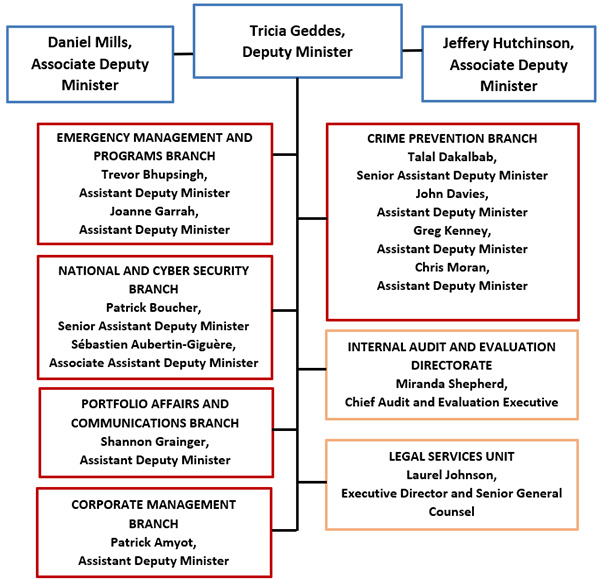
Image description
Tricia Geddes,
Deputy Minister
Daniel Mills,
Associate Deputy Minister
Jeffery Hutchinson,
Associate Deputy Minister
Emergency Management and Programs Branch
Trevor Bhupsingh,
Assistant Deputy Minister
Joanne Garrah,
Assistant Deputy Minister
National and Cyber Security Branch
Patrick Boucher,
Senior Assistant Deputy Minister
Sébastien Aubertin-Giguère,
Associate Assistant Deputy Minister
Portfolio Affairs and Communications Branch
Shannon Grainger,
Assistant Deputy Minister
Corporate Management Branch
Patrick Amyot,
Assistant Deputy Minister
Crime Prevention Branch
Talal Dakalbab,
Senior Assistant Deputy Minister
John Davies,
Assistant Deputy Minister
Greg Kenney,
Assistant Deputy Minister
Chris Moran,
Assistant Deputy Minister
Internal Audit and Evaluation Directorate
Miranda Shepherd,
Chief Audit and Evaluation Executive
Legal Services Unit
Laurel Johnson,
Executive Director and Senior General Counsel

Image description
Michael Duheme
Commissioner
RCMP Legal Services
Patrick Vézina,
Executive Director and Senior General Counsel
Chief Administrative Officer
Vacant
Senior Deputy Commissioner
Brian Larkin
Contract & Indigenous Policing
Jodie Boudreau [REDACTED]
DeAnna Hill (interim)
Deputy Commissioner
Federal Policing
Mark Flynn,
Deputy Commissioner
Specialized Policing Services
Marie-Claude Dandenault,
Deputy Commissioner
Commanding Officer "E" Division British Columbia
Dwayne McDonald,
Deputy Commissioner
Commanding Officer "K" Division Alberta
Rob Hill,
Deputy Commissioner
Chief Human Resources Officer
Jasmin Breton
Corporate Management & Comptrollership
Samantha Hazen,
Chief Financial Officer
Reform, Accountability and Culture
Alison Whelan,
Senior Assistant Deputy Minister
Professional Responsibility Sector
Alfredo Bangloy Jr.,
Assistant Commissioner
Strategic Policy & External Relations
Rouben Khatchadourian,
Chief Strategic Policy & External Relations Officer
Internal Audit, Evaluation and Review
Ian Raskin,
Chief Audit and Evaluation Executive
Independent Centre for Harassment Resolution
Amanda Nemer,
Executive Director
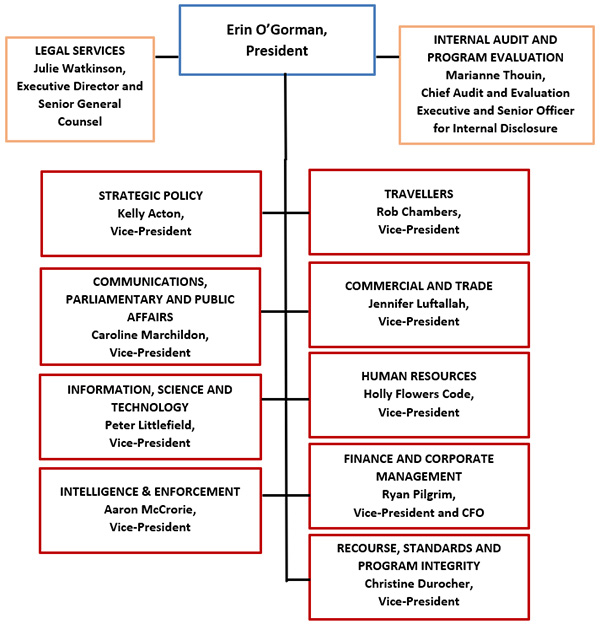
Image description
Erin O'Gorman,
President
Legal Services
Julie Watkinson,
Executive Director and Senior General Counsel
Internal Audit and Program Evaluation
Marianne Thouin,
Chief Audit and Evaluation Executive and Senior Officer for Internal Disclosure
Strategic Policy
Kelly Acton,
Vice-President
Communications, Parliamentary and Public Affairs
Caroline Marchildon,
Vice-President
Information, Science and Technology
Peter Littlefield,
Vice-President
Intelligence & Enforcement
Aaron McCrorie,
Vice-President
Travellers
Rob Chambers,
Vice-President
Commercial and Trade
Jennifer Luftallah,
Vice-President
Human Resources
Holly Flowers Code,
Vice-President
Finance and Corporate Management
Ryan Pilgrim,
Vice-President and CFO
Recourse, Standards and Program Integrity
Christine Durocher,
Vice-President
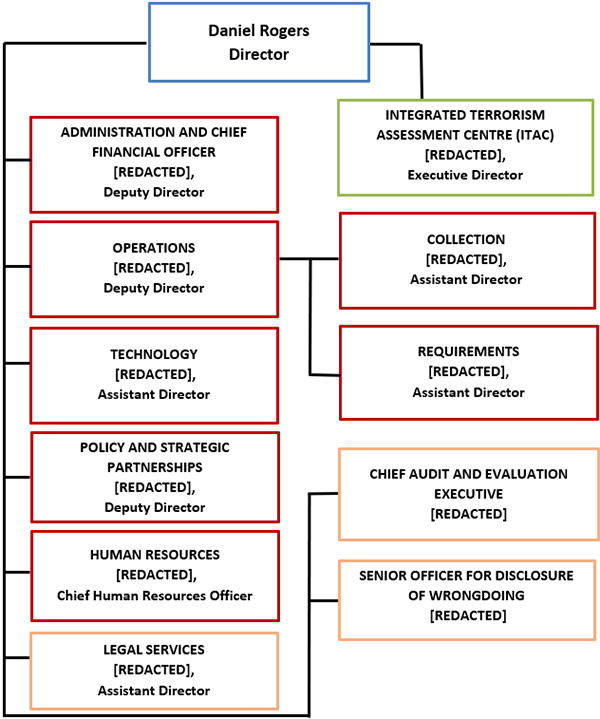
Image description
Daniel Rogers
Director
Administration and Chief Financial Officer
[REDACTED],
Deputy Director
Operations
[REDACTED],
Deputy Director
Technology
[REDACTED],
Assistant Director
Policy and Strategic Partnerships
[REDACTED],
Assistant Director
Human Resources
[REDACTED],
Chief Human Resources Officer
Legal Services
[REDACTED],
Assistant Director
Integrated Terrorism Assessment Centre (ITAC)
[REDACTED],
Executive Director
Collection
[REDACTED],
Assistant Director
Requirements
[REDACTED],
Assistant Director
Chief Audit and Evaluation Executive
[REDACTED]
Senior Officer for Disclosure of Wrongdoing
[REDACTED]
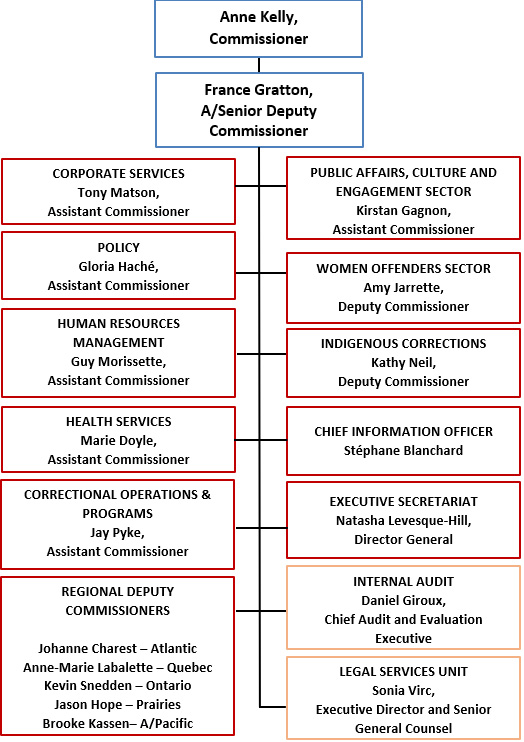
Image description
Anne Kelly,
Commissioner
France Gratton,
A/Senior Deputy Commissioner
Corporate Services
Tony Matson,
Assistant Commissioner
Policy
Gloria Haché,
Assistant Commissioner
Human Resources Management
Guy Morissette,
Assistant Commissioner
Health Services
Marie Doyle,
Assistant Commissioner
Correctional Operations & Programs
Jay Pyke,
Assistant Commissioner
Regional Deputy Commissioners
Johanne Charest – Atlantic
Anne-Marie Labalette – Quebec
Kevin Snedden – Ontario
Jason Hope – Prairies
Brooke Kassen – A/Pacific
Public Affairs, Culture and Engagement Sector
Kirstan Gagnon,
Assistant Commissioner
Women Offenders Sector
Amy Jarrette,
Deputy Commissioner
Indigenous Corrections
Kathy Neil,
Deputy Commissioner
Chief Information Officer
Stéphane Blanchard
Executive Secretariat
Natasha Levesque-Hill,
Director General
Internal Audit
Daniel Giroux,
Chief Audit and Evaluation Executive
Legal Services Unit
Sonia Virc,
Executive Director and Senior General Counsel
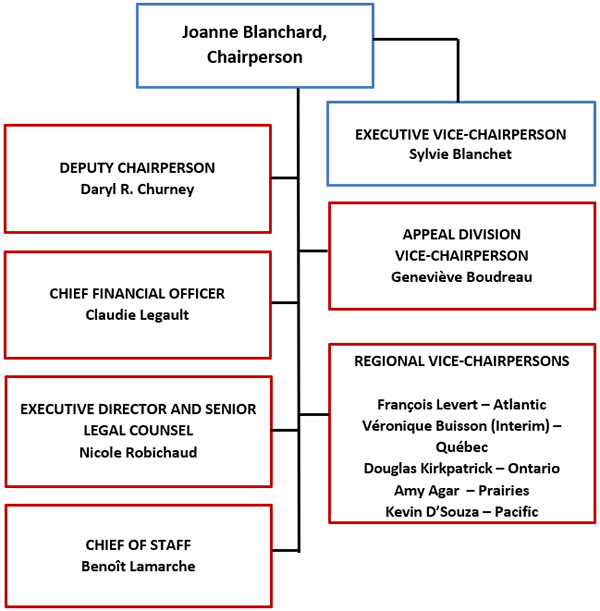
Image description
Joanne Blanchard,
Chairperson
Executive Vice-Chairperson
Sylvie Blanchet
Deputy Chairperson
Daryl R. Churney
Chief Financial Officer
Claudie Legault
Executive Director and Senior Legal Counsel
Nicole Robichaud
Chief of Staff
Benoît Lamarche
Appeal Division
Vice-Chairperson
Geneviève Boudreau
Regional Vice-Chairpersons
François Levert – Atlantic
Véronique Buisson (Interim)– Québec
Douglas Kirkpatrick – Ontario
Amy Agar– Prairies
Kevin D'Souza – Pacific
Footnotes
- Footnote 1
-
The Department's legal name is the Department of Public Safety and Emergency Preparedness. The Department is commonly referred to as Public Safety Canada (PS). The legal name must be used in statutory instruments, such as legislation or Orders in Council, as well as other types of documents that have legal effect, including contracts or other formal agreements.
- Date modified: