Requests for federal assistance
About requests for federal assistance
In Canada, emergencies are managed first at the local level: hospitals, fire departments, police and municipalities. If they need assistance at the local level, they request it from their province or territory. If the emergency escalates beyond their capacity, the province or territory seeks assistance from the federal government.
A request for federal assistance (RFA) is how a province or territory formally requests support from the federal government in their emergency response efforts. The RFA involves official communication and coordination between provincial, territorial or federal departments and Public Safety. It outlines the additional resources the jurisdiction needs for an effective response.
The province or territory submits a formal RFA to describe what they would need in federal government support for a successful emergency response. The well-established process in place for managing RFAs, through the Government Operations Centre (GOC), includes interdepartmental consultation and coordination.
RFAs can include support for:
- Operational Coordination;
- Emergency Evacuation, Transportation and logistics;
- Specialized Response Resources for Wildland Interface fires, flooding, hurricane and extreme weather; and
- Emergency Public Health, Medical and Social Services.
The GOC continues to coordinate formal requests for assistance from federal departments and provincial and territorial governments.
RFAs can range from straightforward to complex requiring significant and sustained responses. Public Safety's regional offices and the GOC collaborate with the province or territory and other federal government partners to assess and address requests, whether through federal departments or non-government organizations.
Public Safety's Government Operations Centre is ready to respond to any situation, at any time. Its all-hazards approach to planning, response and support means the Government of Canada can adapt quickly, under any circumstance, when a province or territory asks for help.
How emergencies are managed in Canada
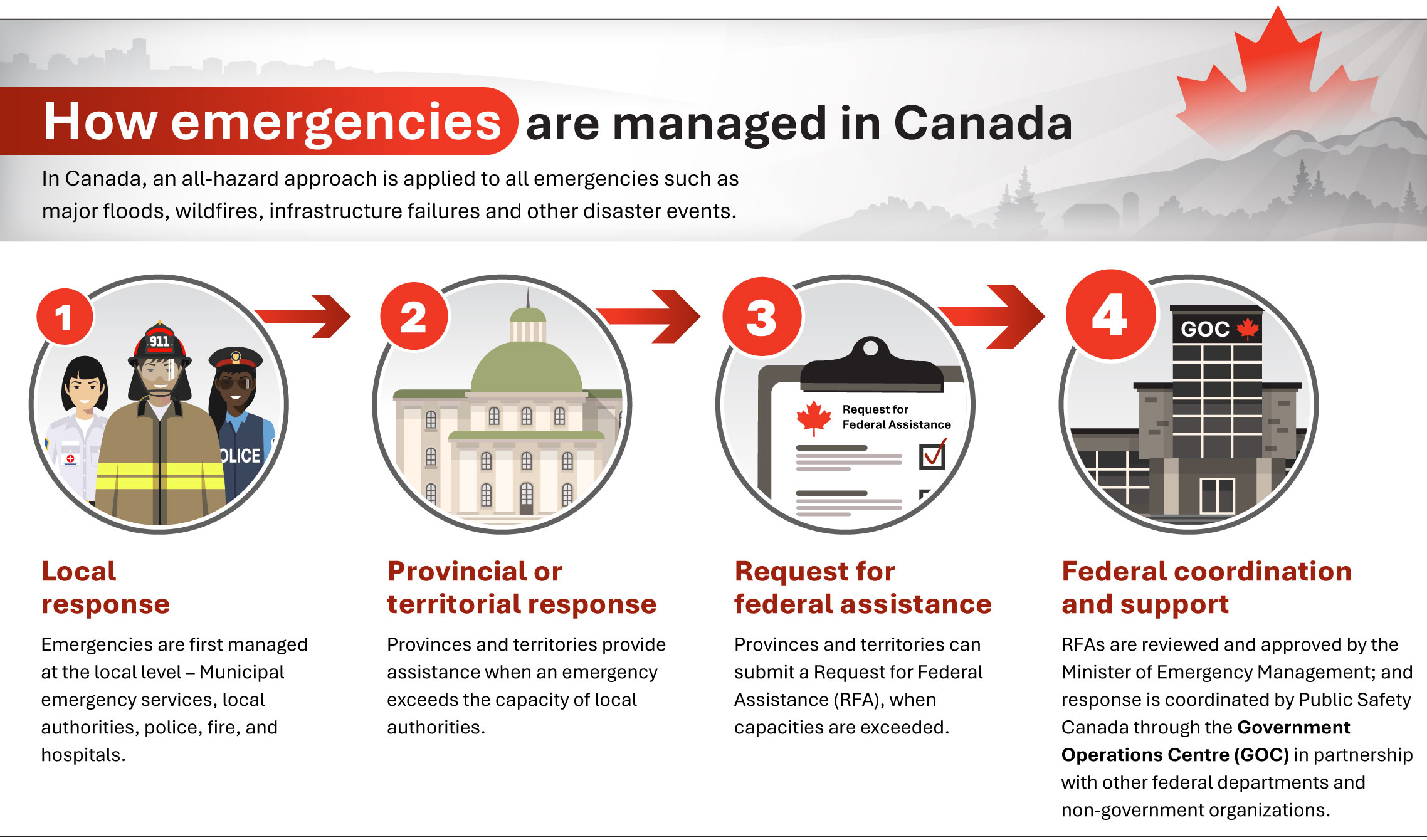
Image description: How emergencies are managed in Canada
The image is an infographic that illustrates how emergencies are managed in Canada. In Canada, an all-hazard approach is applied to all emergencies such as major floods, wildfires, infrastructure failures and other disaster events. The image illustrates the four steps involved in the process from left to right each with an icon and an arrow pointing to the next step.
Step 1: Local Response – Emergencies are first managed at the local level – Municipal emergency services, local authorities, police, fire, and hospitals. (Icon: group of first responders)
Step 2: Provincial or territorial response – Provinces and territories provide assistance when an emergency exceeds the capacity of local authorities. (Icon: government building)
Step 3: Request for Federal Assistance – Provinces and territories can submit a Request for federal assistance (RFA), when capacities are exceeded. (Icon: checklist with a Canadian maple leaf in the header to signify a Government of Canada document)
Step 4: Federal coordination and support – RFAs are reviewed and approved by the Minister of Emergency Management; and response is coordinated by Public Safety Canada through the Government Operations Centre (GOC) in partnership with other federal departments and non-government organizations. (Icon: building of the Government Operations Center (GOC))
Approved requests for federal assistance
| Province / Territory | Date RFA approved | Type of emergency | Assistance details |
|---|---|---|---|
| British Columbia | August 9, 2026 Minister Olszewski approved a Request for Federal Assistance to provide shelter and accommodations to those who have been forced to leave their homes due to wildfires across the province. |
Wildfire |
|
| Ontario | July 17, 2026 Minister Olszewski approved emergency assistance with the evacuation of Eabametoong First Nation (Fort Hope), Ontario, due to the threat posed by wildfires |
Wildfire |
|
| Manitoba | Flooding |
|
|
| Nunavut | April 11, 2026 |
Power outage |
|
| Manitoba | April 9, 2026 |
Flooding |
|
| Manitoba | January 9, 2026 Emergency assistance to Pimicikamak Cree Nation |
Failure of the power distribution line |
|
Previous requests for federal assistance
2025
| Province / Territory | Date RFA approved | Type of emergency | Assistance details |
|---|---|---|---|
| Nunavut | December 9, 2025 Emergency assistance to Inuit community in Nunavut |
Drinking water supply problems |
|
Nova Scotia |
October 9, 2025 |
Wildfire |
|
| Nova Scotia | September 25, 2025 Additional support provided to Nova Scotia regarding the wildfires situation |
Wildfire |
|
| Nova Scotia | September 11, 2025 Additional support provided to Nova Scotia regarding the wildfires situation |
Wildfire |
|
| Nova Scotia | August 16, 2025 Statement from Minister Olszewski regarding wildfires in Nova Scotia |
Wildfire |
|
| Saskatchewan | August 10, 2025 |
Wildfire |
|
| Manitoba | August 8, 2025 |
Wildfire | Several non-governmental organizations participating in the Humanitarian Workforce Program continued to provide the following:
|
| Newfoundland and Labrador | August 6, 2025 Statement from Minister Olszewski regarding wildfires in Newfoundland Labrador |
Wildfire |
Humanitarian Workforce Program
Public Health Agency of Canada
|
| Saskatchewan | July 23, 2025 Statement from Minister Olszewski regarding wildfires in Saskatchewan |
Wildfire |
|
| Manitoba | July 12, 2025 Statement from Minister Olszewski regarding wildfires in Manitoba |
Wildfire | Several non-governmental organizations participating in the Humanitarian Workforce Program confirmed they are able support the tasks below:
|
| Manitoba | July 9, 2025 Statement from Minister Olszewski regarding wildfires in Manitoba |
Wildfire |
|
| Ontario | June 7, 2025 Statement from Minister Olszewski regarding wildfires in Ontario |
Wildfire |
|
| Manitoba | May 29, 2025 Statement from Minister Olszewski regarding wildfires in Manitoba |
Wildfire |
Public Health Agency of Canada
|
| Manitoba | May 29, 2025 Statement from Minister Olszewski regarding wildfires in Manitoba |
Wildfire |
Public Health Agency of Canada
|
| Quebec | May 28, 2025 |
Drinking water supply problems |
|
| Quebec | May 20, 2025 Emergency assistance to Inuit community in northern Quebec |
Drinking water supply problems |
|
2024
| Province / Territory | Date RFA approved | Type of emergency | Assistance details |
|---|---|---|---|
| Nunavut | October 15, 2024 |
Threat to aviation | The Canadian Armed Forces (CAF) provided a military aircraft to transport passengers of Air India Flight 127 from Iqaluit, NU to their final destination, after the flight was diverted to Iqaluit due to a specific threat to aviation. |
| Alberta | August 21, 2024 |
Wildfires | Public Safety Canada worked with Team Rubicon under the Humanitarian Workforce Program to provide humanitarian and logistical support that can assist impacted residents with immediate needs and post-wildfire mitigation. |
Manitoba |
August 14, 2024 Statement from Minister Sajjan regarding wildfires in northern Manitoba |
Wildfires |
The Canadian Armed Forces (CAF) provided airlift assets to support in evacuation efforts and local personnel from the Canadian Rangers to support logistical tasks deemed necessary. |
Alberta |
August 8, 2024 |
Wildfires |
The Canadian Armed Forces (CAF) were available to provide firefighting resources in the form of Type III firefighters. Public Safety Canada worked with non-governmental organizations under the Humanitarian Workforce Program to provide additional capacity to support Alberta for post-wildfire mitigation, site surveys, damage assessments, and property examinations and debris removal. |
Alberta |
July 24, 2024 Statement from Minister Sajjan regarding the wildfires situation in Alberta |
Wildfires |
The Canadian Armed Forces (CAF) were available to provide firefighting resource, pre-positioning of strategic airlift resources for the evacuation of isolated communities, air support to move wildfire crews and equipment, and logistics support. Other federal departments such as Parks Canada, Public Services and Procurement Canada, Canadian Coast Guard and Employment and Social Development Canada were prepared to provide assistance under their own respective mandates to assist the province of Alberta if needed. |
Newfoundland and Labrador |
July 13, 2024 Statement from Minister Sajjan regarding wildfires in Newfoundland and Labrador |
Wildfires | The Canadian Armed Forces were available to provide the accommodations and provision of food services to those at 5 Wing Goose Bay. Public Safety Canada worked with provincial officials to better assess the requirements for humanitarian workforce. |
| Nova Scotia | February 5, 2024 Government of Canada announces assistance to Nova Scotia with recovery efforts following significant snow storm |
Snow Storm | Parks Canada (PC) provided resources to clear snow within the Cape Breton Highlands National Park and up to 10km outside of the park boundaries. Additionally, PC made a number of snowmobiles available. The Canadian Coast Guard (CCG) provided airlift assets to support the transport of personnel and supplies as required. Members of the Canadian Coast Guard College contributed to the snow removal efforts. Additionally, CCG offered to procure fuel bladders to assist with the transportation of fuel, if required. Public Services and Procurement Canada supported the province by providing advice for the procurement of commercial options to assist in the provincial response to the impacts of this event. The Canadian Armed Forces were available to provide search and rescue in life or limb situations. |
- Date modified: